Gravimetric vs. Volumetric Dosers: A Comprehensive Analysis and Selection Guide
- 2026.04.21
- Flying Tiger
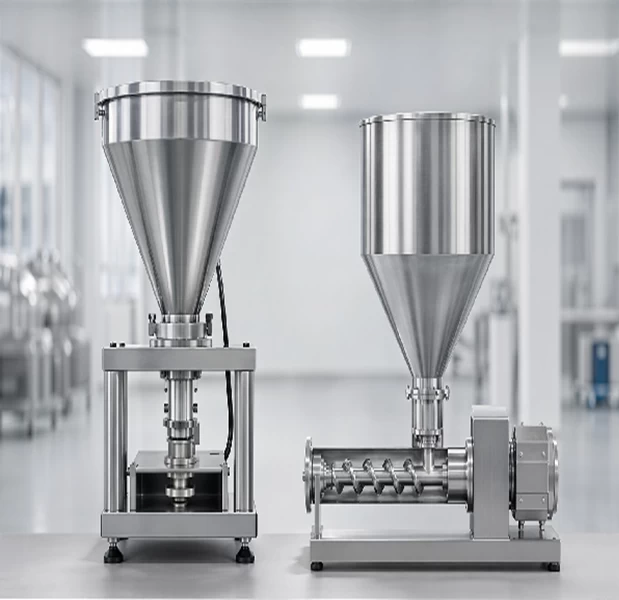
In precision manufacturing, "close enough" is the enemy of excellence. To achieve a high-end finish and structural perfection, the chemistry of your melt must be flawless. Choosing between a gravimetric vs. volumetric blender is a decision that impacts your brand’s reputation for quality and your bottom line.
Quick Summary: The 0.1% Precision Advantage
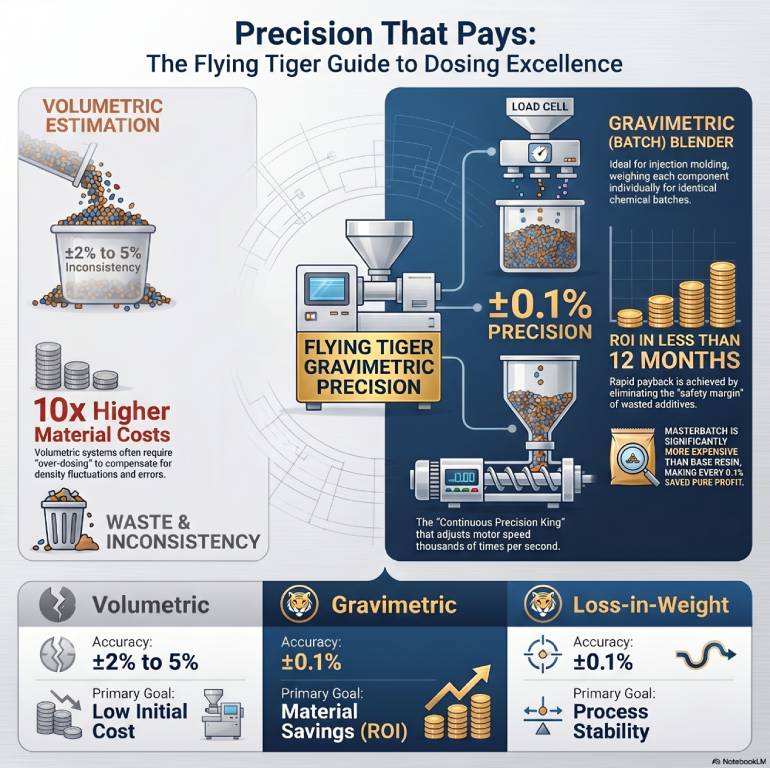
While volumetric blenders measure by estimation (speed/time), Flying Tiger Gravimetric Blenders and Loss-in-Weight Feeders utilize ultra-high-resolution load cells to achieve a dosing accuracy of ±0.1%. This extreme precision allows manufacturers to reduce masterbatch usage to the absolute minimum, turning saved material costs into direct company profit.
1. Why 0.1% Dosing Precision is the Key to Unlocking Annual Profit Margins
Many manufacturers view a doser as just a peripheral, but in reality, it is a Profit Generator.
Masterbatch is often 5x to 10x more expensive than base resin. Because volumetric systems are inconsistent (with errors up to 5%), operators often "over-dose" (e.g., adding 4% instead of the required 3%) as a safety margin.
The "0.1% Precision" Profit Formula:
By switching to a Flying Tiger Gravimetric System, you can confidently reduce your dosing ratio to the absolute minimum specification. Every 0.1% of masterbatch saved doesn't just reduce "cost"—it goes directly to your company's bottom line as pure profit.
2. How to Select the Right Dosing Technology
Not every process requires the same level of technology. Selecting the right system depends on the "Cost of Error" in your production line.
Volumetric Dosers: The Budget-Friendly Entry
- Best for: Non-critical applications with low-cost materials.
- Mechanism: Measures by "space" (volume) using a screw or disc at a set speed.
- The Risk: It cannot detect density fluctuations. If your regrind size varies, the doser will "guess" incorrectly, leading to color shifts.
Gravimetric (Batch) Blenders: The High-Quality Standard
- Best for: Most injection molding and extrusion processes requiring high consistency.
- Mechanism: Weighs each component individually in a weigh hopper before mixing.
- The Advantage: Achieving ±0.1% accuracy ensures every batch is chemically identical, regardless of material density changes.
Loss-in-Weight (LIW) Feeders: The Continuous Precision King
- Best for: Continuous extrusion, high-speed compounding, and "starve-feeding."
- Mechanism: The entire hopper sits on a scale; the system adjusts motor speed thousands of times per second to maintain a constant flow.
- The Advantage: It is the most proactive system, correcting flow in real-time to maintain a strict 0.1% tolerance.
3. Comparison Summary: Selection Decision Matrix
| Factor | Volumetric | Flying Tiger Gravimetric | Flying Tiger Loss-in-Weight |
|---|---|---|---|
| Accuracy | ±2% to 5% | ±0.1% | ±0.1% |
| Primary Goal | Low Initial Cost | Material Savings (ROI) | Process Stability |
| Calibration | Manual / Frequent | Automatic | Real-time / Proactive |
| Material Cost | Low (Base resins) | High (Special additives) | High (Continuous flow) |
| Direct Profit | Low | High (Saves 10-20% MB) | High (Consistent Output) |
4. Economic Mastery: Loss-in-Weight Feeder Advantages
Using a loss-in-weight feeder with 0.1% accuracy allows you to "dial in" your additive percentages with scientific precision. By eliminating the "safety over-dosing" common in volumetric systems, most clients realize a blender ROI calculation of less than 12 months.
Why Global Leaders Choose Flying Tiger Dosing Systems
- Precision: 0.1% Gravimetric control that eliminates human error and material waste.
- Efficiency: Automated recipes that reduce setup time by 70%.
- Durability: Heavy-duty construction designed for decades of 24/7 operation.
- Profitability: Turning "material cost" into "competitive advantage."


Back