Cooling & Chilled Water
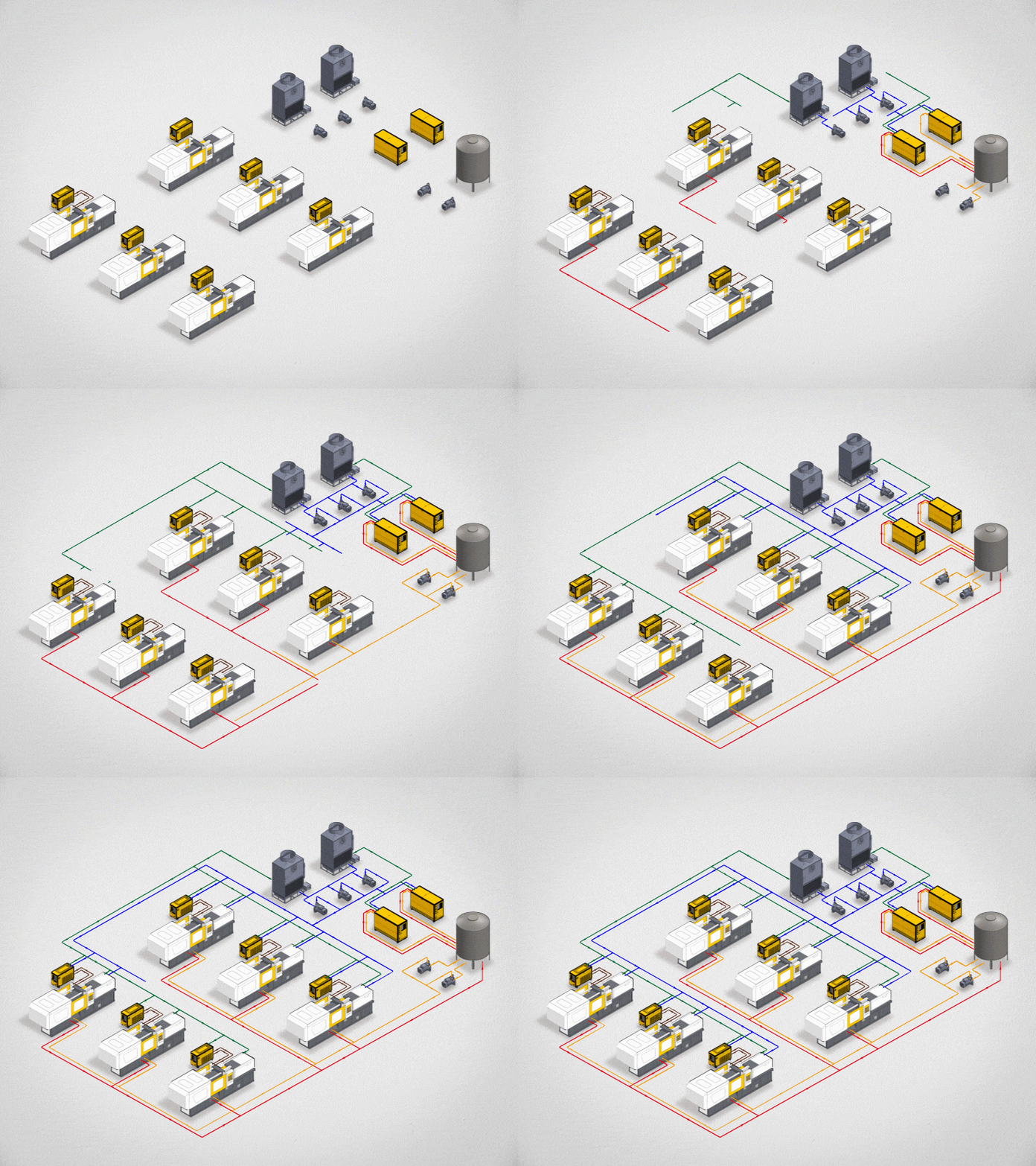
What Is a Central Chilled Water System?
A central chilled water system consolidates the cooling capacity for an entire factory into a shared infrastructure — replacing individual dedicated chillers at each machine with a centralized chiller plant that distributes precisely temperature-controlled chilled water to all process points through an insulated piping network. This architecture is the standard in semiconductor fabs, pharmaceutical plants, and large-scale food processing; in plastics manufacturing, it is increasingly adopted by high-volume operations seeking to reduce energy costs, simplify maintenance, and improve plant-wide cooling stability.
A centralized approach offers fundamental efficiency advantages: chillers operate closer to their optimal coefficient of performance (COP) at higher aggregate loads, partial-load conditions are handled far more efficiently by one large VFD-controlled unit than by many small fixed-speed machines, and maintenance is concentrated rather than distributed across dozens of individual units.
Key Challenges in Industrial Process Cooling
- ● Temperature instability
Fluctuations in cooling water temperature directly cause dimensional variation in molded parts, surface defects,
extended cycle times, and increased scrap rates. Different processes and mold sizes require different supply temperatures,
demanding a flexible distribution architecture. - ● Energy waste in partial-load operation
Traditional fixed-speed chillers run at full compressor power regardless of actual cooling demand.
During cooler seasons, night shifts, or partial production, this represents significant and avoidable energy waste. - ● Water quality and fouling
Open cooling tower systems accumulate scale, algae, and biological contamination that progressively foul
heat exchanger surfaces, reducing chiller efficiency and shortening equipment life.
In PET preform and clean-room molding environments, open tower water quality can also affect product cleanliness. - ● Monitoring and accountability
Large plants with dozens of machines face difficulty maintaining visibility into cooling performance across zones and
identifying which machines or molds are underperforming thermally.
Flying Tiger KJ's Cooling & Chilled Water Solutions
Flying Tiger KJ provides a complete portfolio of cooling infrastructure — from individual machine-side units to full central chilled water plant design — covering injection molding, blow molding, extrusion, PET processing, and compounding applications.
- ● Inverter Water Cooling Chiller
The foundation of Flying Tiger KJ's cooling offering. Equipped with variable-frequency drive (VFD) compressor technology,
it continuously modulates refrigeration output to match actual plant cooling demand, delivering verified energy savings
of 30–50% versus conventional fixed-speed chillers. - ● Compounding Efficiency as a Central Cooling Source
When configured as the central cooling source for multiple machines simultaneously,
the efficiency advantage compounds further as the chiller consistently operates at high-efficiency partial-load points. - ● SUS Close-Type Cooling Tower
For plants concerned about biological fouling and scale accumulation, the SUS Close-Type Cooling Tower
provides a fully enclosed, stainless steel cooling loop that physically isolates process water from atmospheric contaminants.
This eliminates biological growth, dramatically reduces chemical treatment requirements,
and protects chiller heat exchangers from fouling, extending equipment service life and
maintaining peak heat transfer efficiency year-round. Its all-stainless construction makes it especially suitable for
PET preform molding, medical device manufacturing, and other clean-environment applications. - ● Mold Temperature Controllers
At the machine level, Flying Tiger KJ's Mold Temperature Controllers —
available in water type (ambient to 180°C) and oil type (up to 350°C),
both with ±0.5°C precision — complete the temperature control loop at each press independently of
fluctuations in the central supply temperature.
Contact Flying Tiger KJ for a full cooling system audit and energy analysis, comparing your current individual chiller setup against a centralized inverter chiller architecture — including projected energy savings and ROI timeline.