Compounding
What Is Plastic Compounding?
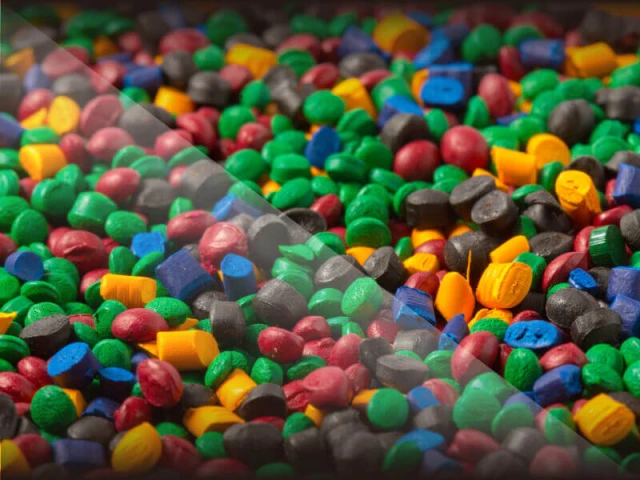
Plastic compounding is the process of melt-mixing a base polymer resin with additives, fillers, colorants, flame retardants, reinforcing agents, or other polymers in a twin-screw extruder or internal mixer to produce a customized compound with specific performance characteristics. The resulting pellets become the feedstock for downstream injection molding, blow molding, extrusion, and film operations.
Compounding is applied across a wide range of industries — automotive (under-hood components, bumpers), electrical & electronics (connectors, housings), medical (biocompatible compounds), construction (flame-retardant profiles), and packaging (barrier films, colored resins). The precision and flexibility of the compounding process determines the final product’s quality, compliance, and cost competitiveness.
Key Challenges in Compounding Operations
- ● Dosing accuracy
Even small deviations in additive ratios cause off-spec batches, customer rejections, and raw material waste.
Multi-component recipes demand synchronized, continuous feeding of resins, regrind, masterbatches,
fillers, and reactive additives simultaneously. - ● Material moisture management
High-temperature compounding processes are sensitive to residual moisture in hygroscopic resins.
Inadequate pre-drying leads to hydrolytic degradation, volatile generation, and poor melt quality. - ● Recipe flexibility
Compounders typically run many different formulations across the same lines.
Dosing systems must be reconfigurable quickly with minimal downtime between product changes. - ● Raw material logistics
Managing multiple raw material types — pellets, powders, regrind, liquids —
across multiple extruder lines requires a flexible and contamination-free conveying infrastructure.
How Flying Tiger KJ Enhances Compounding Performance
Flying Tiger KJ’s compounding solutions are built around three principles: dosing accuracy, pre-drying precision, and seamless system integration.
High-Accuracy Multi-Component Dosing
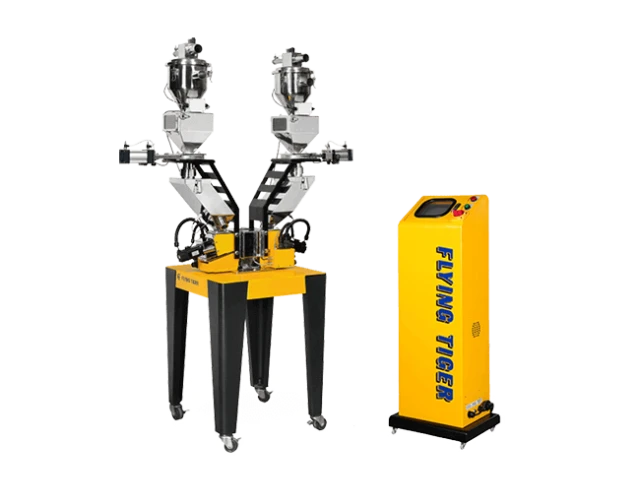
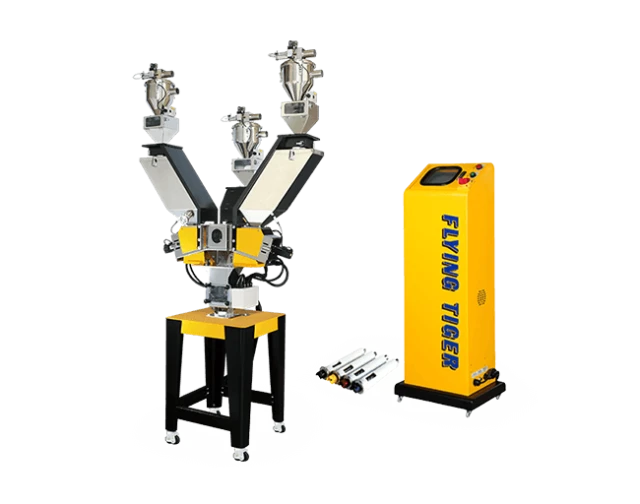
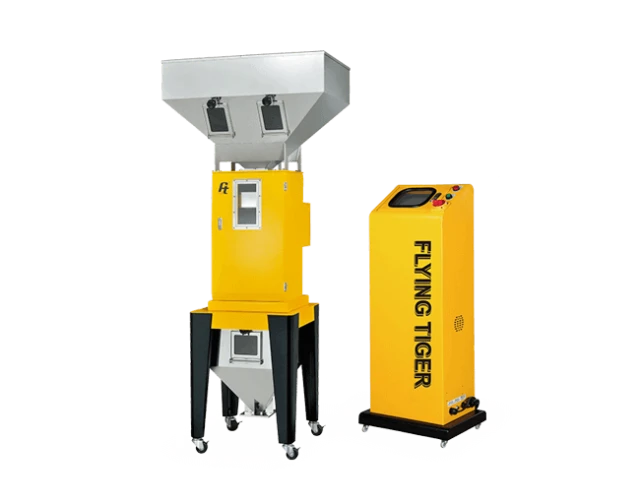
Our Loss-In-Weight Dosing Blender and Gravimetric Dosing Blender deliver continuous, high-accuracy proportioning of multiple components simultaneously, supporting complex multi-component recipes with minimal raw material waste.
For simpler applications, the Volumetric Dosing Blender provides a reliable and economical alternative. All blenders are designed for quick recipe changeover and integration with plant-level MES and ERP systems.
Rapid Vacuum Pre-Drying
Pre-drying performance is a key differentiator in Flying Tiger KJ’s compounding offering. Our proprietary Vacuum Dehumidifying Dryer is particularly effective for PC and PET-based compounds — the vacuum environment below 1 Torr enables drying in 1–2 hours rather than the 4–6 hours of conventional adsorption systems, with more than 30% energy savings.
This speed advantage allows compounders to respond faster to production schedule changes and reduce raw material inventory tied up in the drying queue.
Drying Across Diverse Resin Types
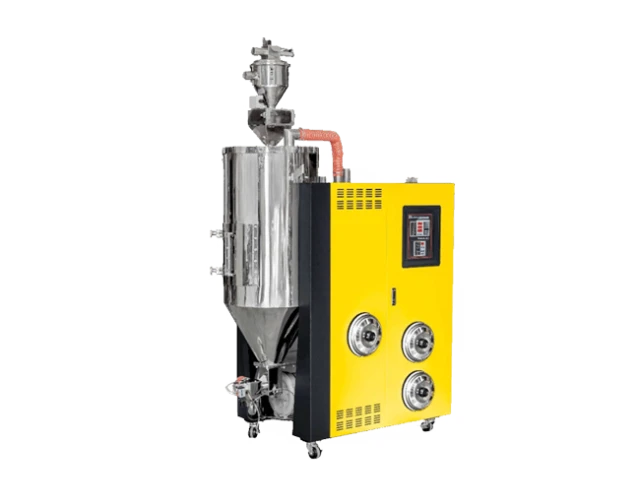
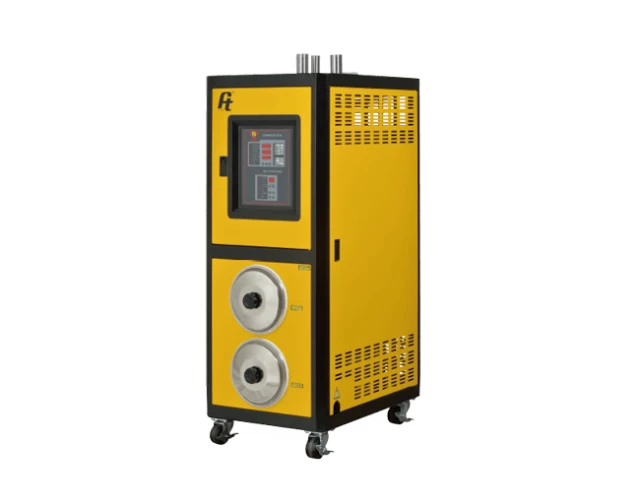
The Three-In-One Dehumidifying Dryer and Honeycomb Dehumidifying Dryer maintain consistent dew points across the broader range of engineering resins that compounders handle daily.
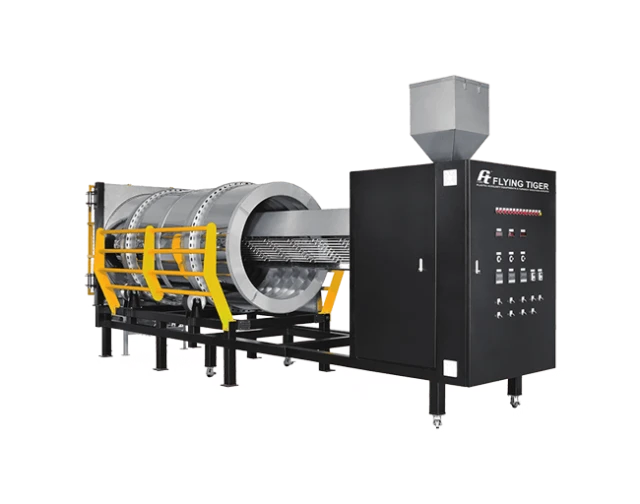
For high-throughput PET compounding and recycling, the patented Infrared Rotary Dryer delivers simultaneous crystallization and drying in a single continuous operation, maximizing throughput while protecting IV value.
Automated Raw Material Supply
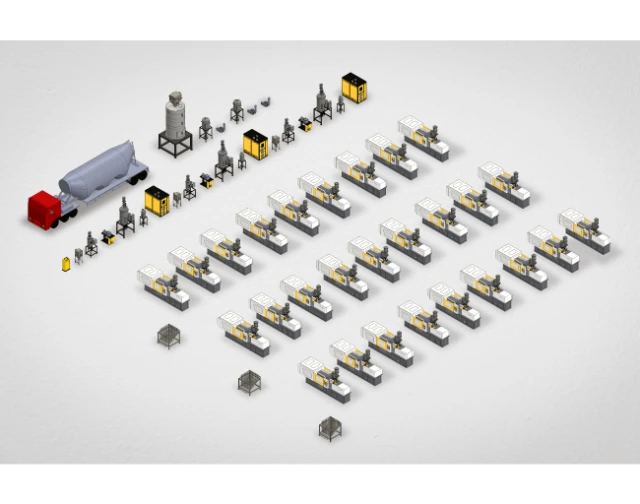
The Central Material Conveying System automates the supply of raw materials — pellets, regrind, and powders — from storage to extruder hoppers across multiple lines, eliminating manual bag handling and reducing cross-contamination risk.
Industry 4.0 Monitoring and Traceability
With Industry 4.0 integration, operators can monitor dosing accuracy, drying performance, and material consumption in real time from a single centralized control platform — enabling data-driven quality management and full production traceability.
Contact Flying Tiger KJ today to design a compounding auxiliary solution matched to your formulation complexity, output volume, and automation goals.