What Is PET Extrusion?
PET extrusion is a continuous process where thoroughly dried and crystallized PET resin is melted and pushed through a shaped die to produce sheets, films, strapping, and fibers. Output serves a wide range of end markets: food-grade thermoforming sheet (trays, clamshells, blister packs), biaxially oriented PET film (BOPET), textile polyester fiber, filament yarn, and industrial strapping.
Unlike injection molding where defects appear as discrete parts, PET extrusion produces output continuously — meaning any deviation in moisture content, IV value, or melt temperature propagates without interruption through the entire production roll. This makes the quality of material preparation and temperature control especially critical.
Key Challenges in PET Extrusion
- ● Two-stage drying requirement
Raw or recycled PET pellets typically contain 3,000–5,000ppm moisture.
Food-grade and optical-grade extrusion requires moisture below 50ppm before the barrel.
Bridging this gap in a single drying stage is slow, energy-intensive, and difficult to sustain at scale. - ● IV value preservation
Hydrolytic degradation during extrusion reduces molecular weight (IV value), weakening the sheet or fiber and
reducing barrier properties. Once IV is lost during processing, it cannot be recovered downstream. - ● Temperature uniformity
Sheet and film products are especially sensitive to melt temperature fluctuations,
which cause gauge variation (inconsistent thickness) across the web width
— directly affecting packaging performance and scrap rates. - ● Additive dosing consistency
UV stabilizers, recycled content percentages, nucleating agents, and colorants must be proportioned with high accuracy
to ensure regulatory compliance and batch-to-batch consistency across production rolls.
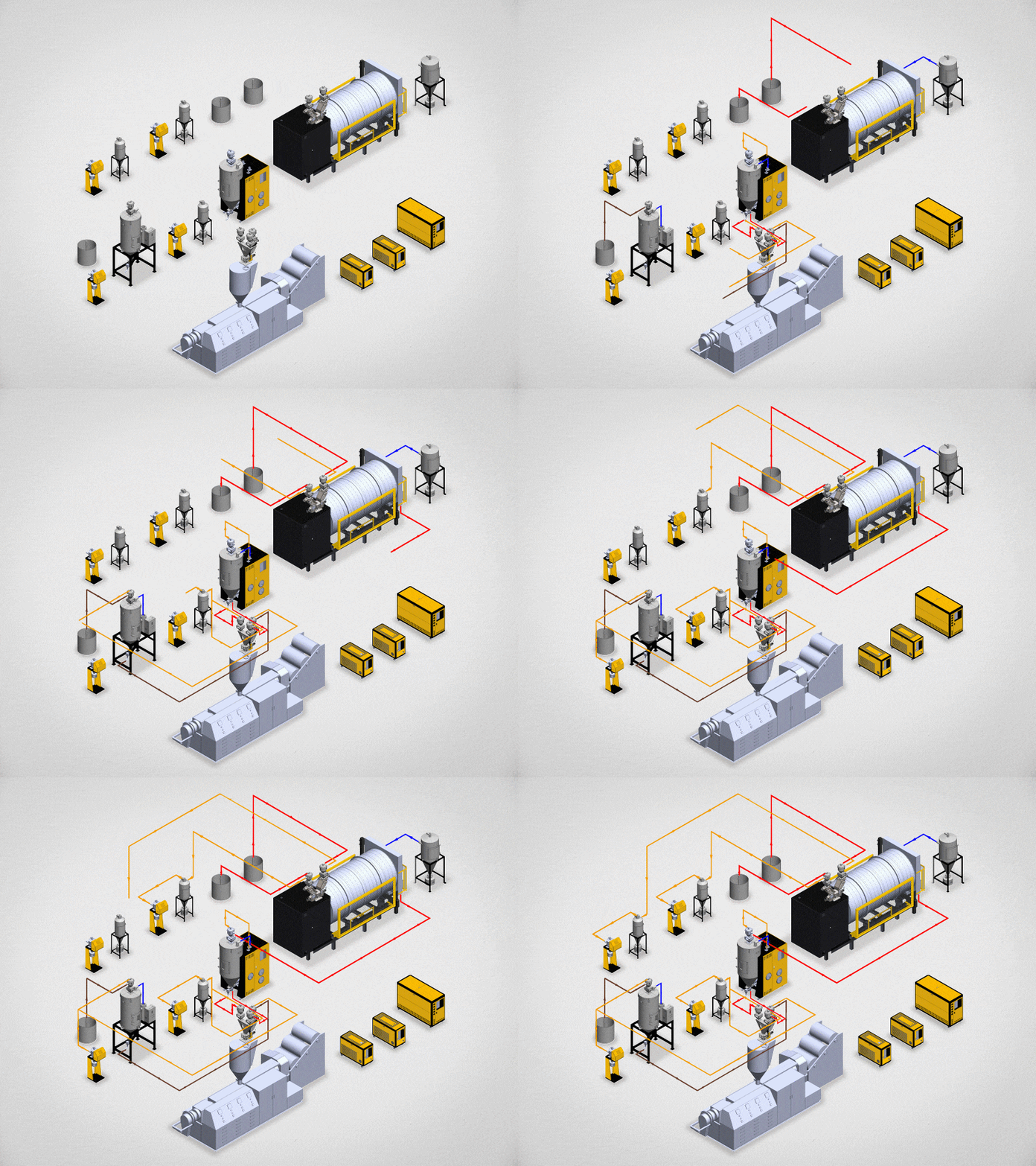
Flying Tiger KJ's PET Extrusion Solution
Flying Tiger KJ has developed a proven two-stage pre-drying system that addresses PET extrusion's moisture challenge efficiently and continuously.
- ● In the first stage, the Infrared Rotary Dryer (IRD)
A patented Flying Tiger KJ innovation — uses far-infrared radiation to simultaneously crystallize and pre-dry PET pellets
in a single continuous operation. Raw PET moisture is reduced from approx. 3,000ppm down to 300–500ppm in just 15 minutes,
with no risk of pellet agglomeration thanks to the IRD's continuous rotation. This dramatically outperforms the
conventional two-unit crystallizer + hopper dryer approach in both speed and energy consumption. - ● In the second stage, Three-In-One Dehumidifying Dryer or the Vacuum Dehumidifying Dryer
The pre-dried material passes through either the Three-In-One Dehumidifying Dryer
or the Vacuum Dehumidifying Dryer, reducing moisture to below 50ppm.
The Vacuum Dehumidifying Dryer option — operating below 1 Torr to achieve this final stage in just 1–2 hrs versus the 4–6 hrs
of conventional adsorption systems, with over 30% energy savings.
This is a decisive advantage for plants with frequent grade changes or limited dryer buffer capacity. - ● Inverter Air Cooling Chiller
Temperature control across the line is handled by Inverter Air and Water Cooling Chillers (VFD-controlled, 30–50% energy savings)
for roll stack and cooling bath temperatures - ● Water Temperature Controller and Oil Temperature Controller (±0.5°C precision)
For barrel zone and die regulation. - ● Loss-In-Weight Dosing Blender
Ensures precise, real-time proportioning of UV stabilizers, regrind ratios, and colorants at the extruder throat.
Contact Flying Tiger KJ for a customized two-stage PET extrusion drying system designed around your throughput target, input material condition, and output IV value specification.