What Is PET Flake Recycling?
PET flake recycling converts post-consumer or post-industrial PET scrap — typically crushed bottle flakes or off-spec production scrap — into reusable rPET (recycled PET) pellets for food-grade bottles, polyester fiber spinning, sheet extrusion, or industrial strapping. The recycled pellets re-enter the supply chain as a direct substitute for virgin PET resin, closing the material loop and reducing dependence on fossil-based feedstock.
As global demand for recycled content grows — driven by brand owner sustainability targets, Extended Producer Responsibility (EPR) legislation, and food-contact rPET regulations — the quality and IV value of recycled PET output has become as commercially critical as virgin material. Producing food-grade rPET now requires the same moisture control, crystallinity management, and IV preservation previously associated only with virgin PET processing.
Key Challenges in PET Flake Recycling
- ● High initial moisture in flakes
Post-consumer PET bottle flakes typically carry 3,000–10,000ppm moisture and irregular particle sizes.
Achieving sub-50ppm before extrusion demands a high-capacity drying system designed
to handle non-uniform flake geometry without blockages. - ● Crystallization of amorphous flakes
Post-consumer PET flakes are often partially amorphous. Without controlled pre-crystallization,
flakes agglomerate inside conventional hopper dryers — blocking material flow and causing production shutdowns. - ● IV value protection
Each heating cycle reduces PET intrinsic viscosity. Recycled PET entering the extruder under-crystallized, over-heated,
or with residual moisture loses IV value disproportionately — risking failure of food-contact grade specifications
(typically ≥0.72 dl/g). - ● Downstream pellet quality
After re-pelletization, PET strands must be cooled rapidly and uniformly to produce consistent pellet shape, crystallinity,
and size — which directly affects SSP (Solid State Polymerization) performance in the customer's downstream process.
Flying Tiger KJ's PET Flake Recycle Solution
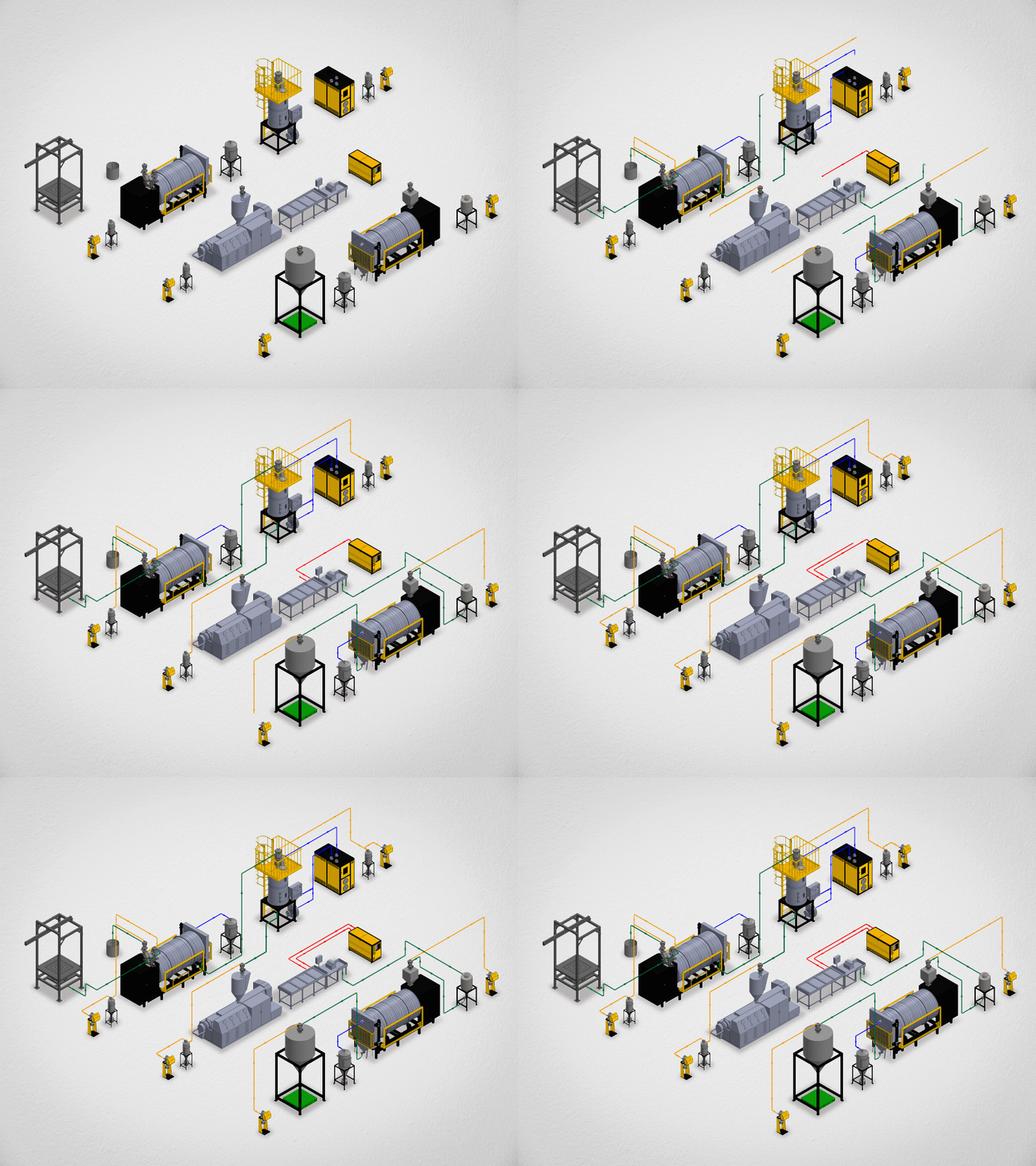
Flying Tiger KJ's rPET processing solution is built around the patented Infrared Rotary Dryer (IRD) as the first-stage treatment unit — the most effective technology for handling the unique challenges of PET flake crystallization and pre-drying.
- ● Infrared Rotary Dryer (IRD)
The IRD reduces flake moisture from 3,000ppm to 300–500ppm in approximately 15 minutes,
simultaneously completing the crystallization step through controlled infrared heating.
Continuous rotation prevents flake agglomeration throughout the process —
a critical advantage over static hopper crystallizers when handling the irregular geometry of post-consumer bottle flakes. - ● Honeycomb Dehumidifying Dryer
Following the IRD, the material enters the Honeycomb Dehumidifying Dryer for final dehumidification to below 50ppm,
maintaining consistent dew point control at varying production rates. - ● Insulated & Dust-Free Hopper Dryer
Provides supplementary heat retention and buffer capacity between process stages when required. - ● Inverter Water Cooling Chiller
At the downstream pelletizing stage, the Cooling Chiller provides precisely temperature-controlled cooling water
to the strand bath, ensuring uniform pellet solidification and consistent geometry across the full output range —
critical for food-contact rPET intended for SSP upgrading
Contact Flying Tiger KJ to design a PET flake recycling auxiliary system matched to your input flake quality, hourly throughput target, and output IV value specification.