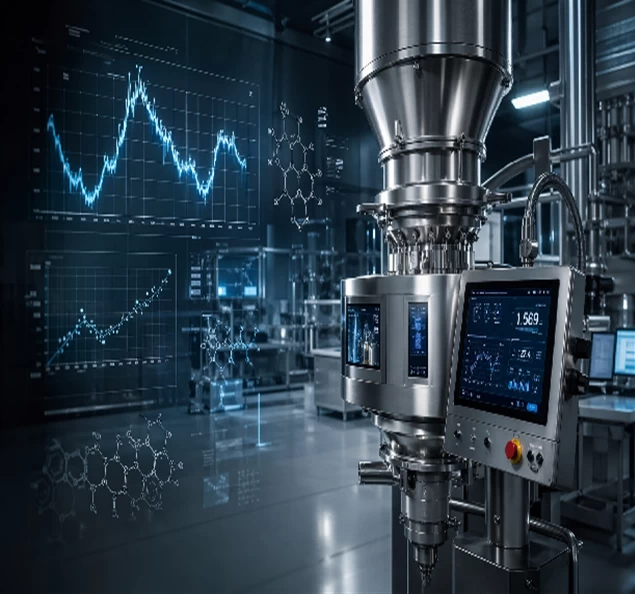
In the push toward a circular economy, incorporating regrind (recycled material) into your production isn't just an environmental choice—it’s a financial necessity. However, for many manufacturers, this transition becomes a "Regrind Nightmare" characterized by inconsistent colors, brittle parts, and constant downtime.
The challenge lies in the physical inconsistency of recycled flakes compared to uniform virgin pellets. At Flying Tiger KJ, we specialize in turning these challenges into high-efficiency advantages through Dual-Control Precision: Gravimetric & Loss-in-Weight technology.
Quick Summary: The Hybrid Precision Advantage
The "Regrind Nightmare" is caused by Bulk Density Variation. Because recycled flakes are irregular, volumetric feeders cannot provide a consistent weight. Flying Tiger KJ systems combine Gravimetric Batch Blending and Loss-in-Weight Continuous Feeding with high-resolution load cells. This dual-capability ensures that even if your regrind density fluctuates or your addition ratios change, the system maintains a strict 0.1% dosing accuracy.
1. Why Volumetric Feeders Fail to Handle Regrind Density Shifts
The primary reason volumetric feeders fail when dosing regrind is that the material is never "constant."
- The Inconstancy Factor: In a single production run, the density of your regrind can change from one bag to the next. Furthermore, the percentage of regrind you want to add might need to vary based on availability.
- The Volumetric Failure: A volumetric screw turns at a fixed speed. If a "fluffy" batch of regrind enters the screw, it occupies more space but weighs less. You end up under-dosing, leading to weak parts and color drifting.
- The Weight-Control Solution: * Gravimetric Mode: Precisely weighs each batch component to ensure the ratio is perfect before mixing.
- Loss-in-Weight Mode: Constantly measures the declining weight in the hopper.
- The Result: If the density drops, the controller automatically increases the screw speed in milliseconds to maintain the exact dosing amount by weight, not just by volume.
2. How Active Agitation Prevents Plastic Bridging and Starve-Feeding
Regrind is notorious for its irregular, jagged edges which cause pieces to interlock. This leads to plastic bridging, where the material forms an arch that stops the flow entirely, causing "starve-feeding."
Flying Tiger KJ addresses this through bespoke mechanical engineering:
- Specialized Agitators: Custom-designed internal mixing blades prevent material from interlocking and packing.
- Bridge-Breaking Technology: Integrated vibration or mechanical pulse systems designed specifically for the most difficult recycled flakes.
- Polished Stainless Steel Surfaces: High-end, low-friction finishes ensure a smooth, gravity-defying continuous flow.
3. Excellence in Handling Recycled Plastic Material
Handling regrind requires a durable, heavy-duty solution. Recycled material can be abrasive and contain dust that clogs standard filters and wears down cheap components.
Flying Tiger KJ units are built with:
- Wear-Resistant Components: Hardened steel contact points for long-term durability against abrasive regrind.
- Dust-Proof Seals: High-end sealing technology protects the ±0.1% precision load cells from fine particles common in regrind batches.
4. The Economic Logic: Accuracy = Direct Profit
Masterbatch and additives are your most expensive materials. In a "Regrind Nightmare," manufacturers often over-dose additives by 2–3% just to hide the inconsistencies caused by the regrind.
The "0.1% Precision" Profit Formula
Lower Dosing Ratio + 0.1% Accuracy = Reduced Material Spend = Increased Net Profit.
By utilizing Flying Tiger KJ's Gravimetric & Loss-in-Weight precision, you can reduce your masterbatch "safety margin." Saving just 1% of masterbatch consumption through better accuracy can often pay for the equipment in less than 12 months.
Technical Comparison: Dosing for Regrind
| Factor | Volumetric Feeder | Flying Tiger KJ Systems |
|---|---|---|
| Accuracy | ±2% to 5% (Inconsistent) | ±0.1% (Extreme Precision) |
| Density Handling | Blind to density shifts | Automatic Speed Adjustment |
| Dosing Logic | Volume (Speed/Time) | Gravimetric & Loss-in-Weight |
| Bridging Prevention | Passive / None | Active Agitation & Pulse |
| Profit Impact | High Material Waste | Direct Material Savings |
Engineering Your Sustainable Success
At Flying Tiger KJ, we don't believe you should have to choose between using recycled materials and maintaining high-end quality. Our Gravimetric & Loss-in-Weight Series is fully customizable, allowing us to build a system specifically for your unique regrind percentage and material type.
Eliminate the nightmare and reclaim your margins with the precision of Flying Tiger KJ.


Back