How to Eliminate Silver Streaks and Brittleness: Solving the 3 Critical Moisture Defects in Injection Molding
- 2026.04.21
- TONY WEN / FLYING TIGER KJ CO., LTD.
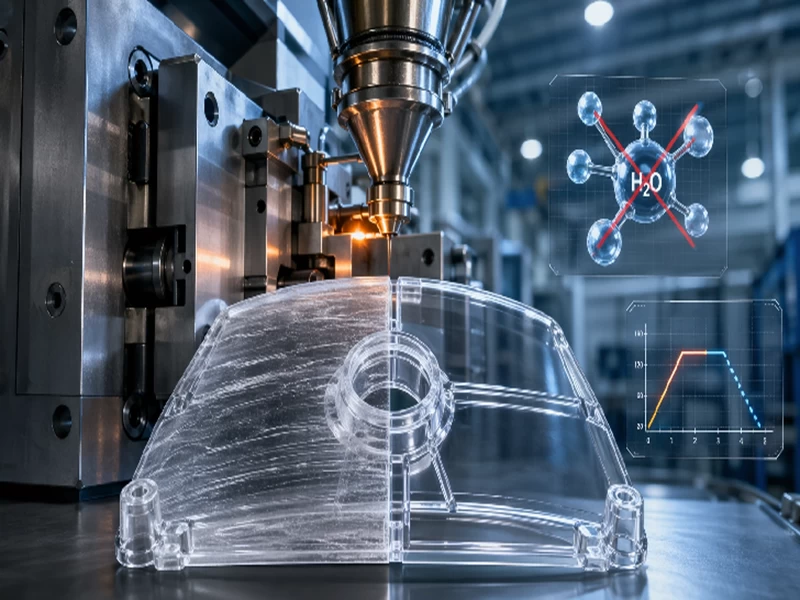
How to Eliminate Silver Streaks and Brittleness: Solving the 3 Critical Moisture Defects in Injection Molding
In the precision-driven world of plastic manufacturing, a single invisible variable can be the difference between a high-performance component and a pile of scrap: residual moisture. While many operators focus on pressure and speed, moisture remains the "invisible killer" of quality. Failing to properly dry resin leads to a cascade of failures, ranging from cosmetic ruin to catastrophic structural breakdown.
Quick Summary: The Essentials of Moisture Control
Moisture in resin is the leading cause of silver streaks (splay) and hydrolysis in injection molding. To ensure structural integrity, hygroscopic materials (like PA, PC, and PET) must be dried to specific moisture levels, often below 0.02%. Using a high-precision dehumidifying dryer with a dew point of -40°C to -50°C is the most effective way to prevent surface defects and molecular degradation.
1. Why Silver Streaks and Splay Marks are the #1 Enemy of Injection Quality
The most immediate sign of moisture trouble is the appearance of silver streaks. These fan-shaped streaks, often appearing near the gate, are technically known as "splay."
Understanding splay marks causes is critical for any floor manager. When moisture-laden plastic pellets enter the high-heat environment of the injection barrel, the water trapped inside turns into pressurized steam. As the melt is injected into the mold, these steam bubbles are dragged along the mold surface, flattening out into the silvery, streaky scars we call splay.
Expert Insight: If you see "foaming" at the nozzle during a purge, your material is far beyond the acceptable moisture limit. At this stage, splay is inevitable without a complete drying cycle.
2. The Hidden Risk: How Hydrolysis Degrades Molecular Chains and Causes Part Failure
While splay is a visual defect, the most dangerous moisture defects in plastic parts are the ones you cannot see. For hygroscopic materials like Nylon (PA), Polycarbonate (PC), and PET, moisture triggers a chemical reaction known as hydrolysis plastic degradation.
This occurs when water molecules react with polymer chains at high temperatures, effectively "cutting" the molecular chains into shorter segments.
- The Result: The part may look perfect on the outside, but its molecular weight is compromised.
- The Consequence: The plastic becomes incredibly brittle, leading to parts that snap or fail under stress during end-use.
3. Troubleshooting Voids vs. Bubbles: Is it Trapped Air or Excessive Moisture?
If your parts are coming out with internal voids or surface blisters, you are likely in the middle of injection molding troubleshooting bubbles.
When moisture content is excessively high, steam cannot escape through the vents and becomes trapped within the part’s wall. Unlike "gas traps" (caused by trapped air), moisture-induced bubbles are usually accompanied by a hazy or cloudy appearance in clear materials.
| Feature | Moisture Bubbles | Vacuum Voids (Shrinkage) |
|---|---|---|
| Appearance | Cloudy, scattered, or silver-ish | Clear, usually in thick sections |
| Root Cause | Improper drying / Dew point failure | Improper cooling / Low packing pressure |
| Solution | Flying Tiger KJ Dehumidifying Dryer | Adjust cooling time and hold pressure |
4. The Solution: Precision Drying and Process Stability
Plastic Resin Drying: The Professional Parameters Guide
This document outlines the drying characteristics, core parameters, and precision drying technical requirements for common plastic materials, providing professional benchmarks for production.
Critical Moisture Defects
- Silver Streaks & Splay Marks: During injection molding, moisture turns into pressurized steam, dragging along the mold surface and creating visible fan-shaped streaks.
- Molecular Hydrolysis: An "invisible" defect occurring in materials like Nylon and PC. Moisture reacts with polymer chains at high heat, causing part brittleness and snapping.
- Internal Voids & Bubbles: Excessive moisture trapped within part walls often results in a cloudy or hazy appearance in clear materials (distinct from vacuum voids).
Essential Drying Parameters
| Material | Drying Temperature (°C) | Drying Time (Hours) |
|---|---|---|
| ABS | 80 | 2 - 3 |
| IONOMER (SURLYN) |
60 | 4 - 8 |
| LCP | 150 | 3 - 4 |
| PA6 / 6.6 / 6.10 / 6.12 |
80 | 4 - 6 |
| PA11 /12 | 80 | 4 - 5 |
| PBT | 140 | 3 - 4 |
| PC | 120 | 3 |
| PC + ABS | 100 | 3 - 4 |
| PEEK | 150 | 3 |
| Material | Drying Temperature (°C) | Drying Time (Hours) |
|---|---|---|
| PEI | 150 | 3 - 4 |
| PES | 160 | 4 |
| PET | 160 | 4 - 6 |
| PETG | 66 | 4 - 5 |
| PMMA | 80 | 2 |
| POM | 100 | 3 |
| PPO | 110 | 2 |
| PPS | 140 | 3 - 4 |
| PUS | 120 | 3 - 4 |
| PU / TPU | 90 | 2 - 4 |
Precision Technology Requirements
- Stable -40°C Dew Point: To guarantee quality for engineering plastics, the dryer must maintain a consistent dew point of -40°C to -60°C during long-term operation.
- Honeycomb Rotor Performance: Advanced ceramic honeycomb rotors operate without powder, ensuring the air remains clean and the dehumidification remains highly efficient.
- 10-14 Month ROI: Investing in high-efficiency dehumidifying systems typically pays for itself within a year through significantly reduced scrap rates and rework.
You cannot manage what you do not control. To eliminate silver streaks and ensure structural integrity, the resin must be dried to its specific PPM (parts per million) requirement before it ever touches the hopper.
At Flying Tiger KJ, we specialize in the "science of stability." Our Dehumidifying & Drying Series provides the rigorous thermal precision required to strip moisture from engineering plastics (maintaining a -40°C dew point) without causing thermal degradation.
Why Proactive Drying is Your Best Investment (ROI):
- Zero Splay: Eliminate rework and scrap by removing the root cause of silver streaks.
- Mechanical Integrity: Prevent hydrolysis to ensure your parts meet their rated strength.
- Faster Recovery: High-efficiency drying systems typically see a return on investment within 10-14 months through reduced scrap rates.
Injection Molding Moisture Control FAQ
Don't Let Moisture Kill Your Margins
Surface defects are a headache, but internal degradation is a liability. By prioritizing the drying phase, you protect your machines, your products, and your reputation.
Ready to upgrade your production quality? Explore our advanced solutions:


Back