How the Right Industrial Chiller Reduces Injection Molding Cycle Time by 20%
- 2026.08.21
- TONY WEN / FLYING TIGER KJ CO., LTD.
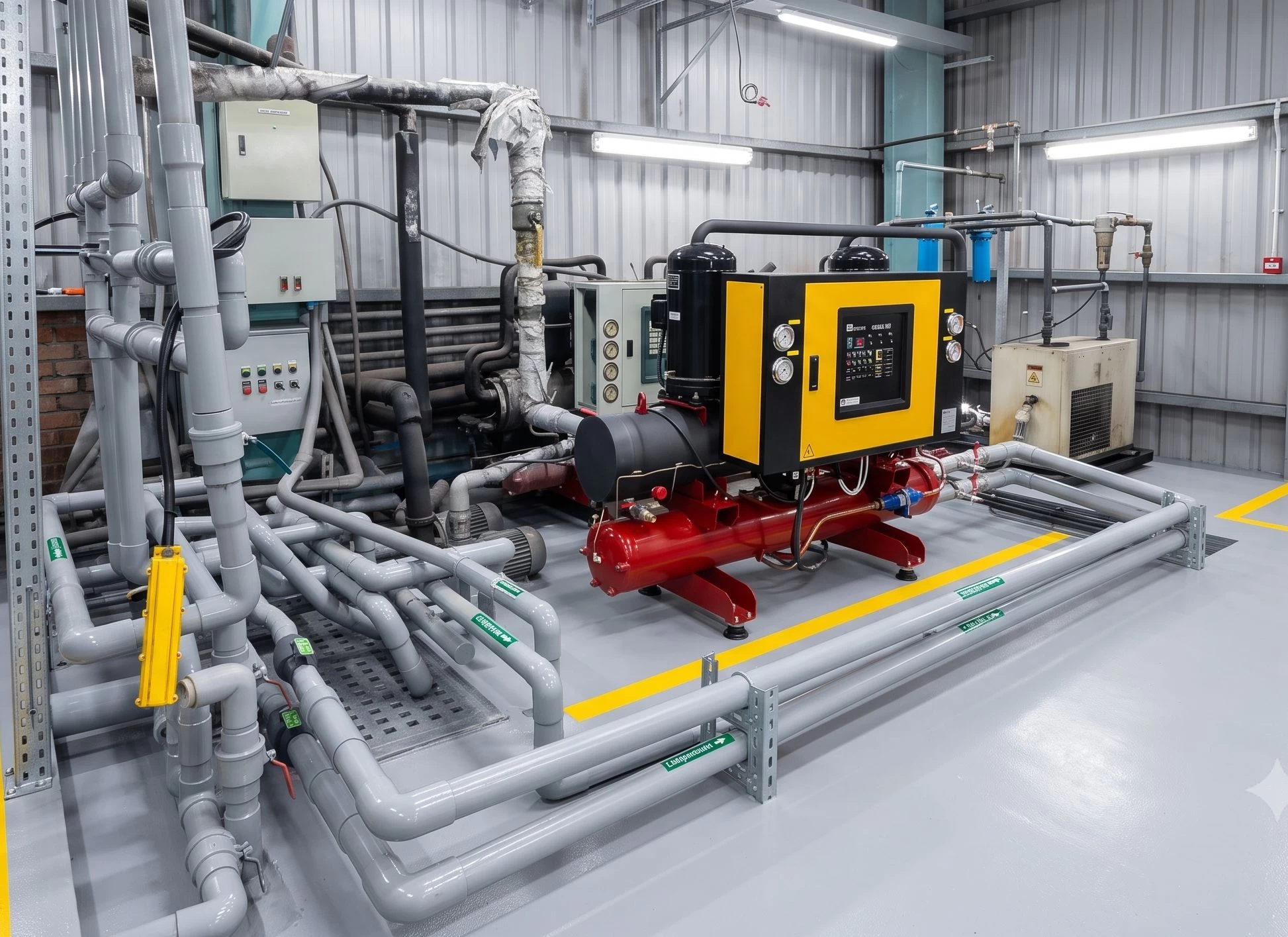
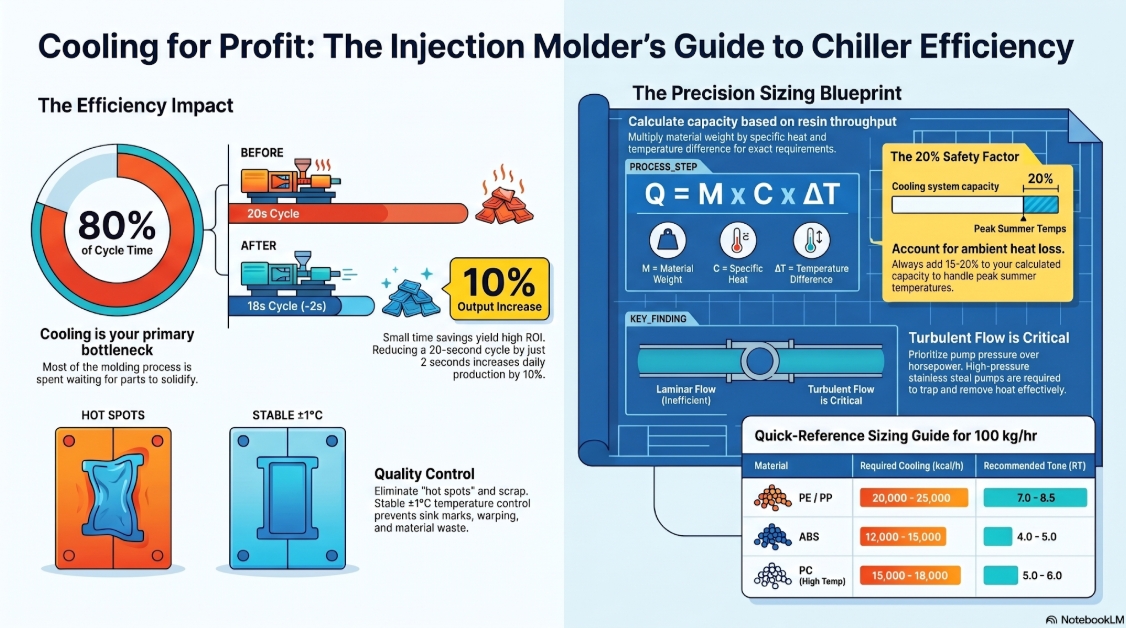
In the high-speed world of injection molding, cooling accounts for nearly 70% to 80% of the total cycle time. If your chiller isn’t sized correctly, your expensive molding machine is essentially sitting idle while waiting for parts to solidify.
Quick Summary: How to Calculate Chiller Tonnage?
To determine the required cooling capacity, use the formula Q = M x C x ΔT.
As a professional rule of thumb, manufacturers should provide 3,000 kcal/h (approx. 1 Ton) of cooling for every 10–15 kg of plastic processed per hour, including a 15-20% safety factor for ambient heat loss and system inefficiencies.
1. The Physics of Profit: Why Horsepower is a Risky Metric
Many manufacturers make the mistake of choosing a chiller based solely on the “horsepower (HP)” of their previous unit. However, true efficiency comes from calculating the Total Heat Load.
- Undersized Systems: The compressor runs 24/7 at max capacity, leading to premature failure and inconsistent mold temperatures that cause sink marks or warping.
- Oversized Systems: The system “short-cycles,” wasting energy and causing unnecessary wear on electrical components.
Flying Tiger Insight: We engineer our air-cooled and water-cooled chillers with high-efficiency compressors and heavy-duty heat exchangers to handle these fluctuations, ensuring ±1°C stability even during peak summer ambient temperatures.
2. Calculate Cooling Capacity Chiller: From Theory to Reality
To ensure you get the right chiller tonnage calculator results, you must calculate the capacity based on your specific resin processing requirements:
Q = M x C x ΔT
- Q: Required Heat Load (kcal/h)
- M: Material throughput per hour (kg/hr)
- C: Specific heat of the plastic resin (kcal/kg·°C)
- ΔT: The temperature difference between the melt temperature and the ejection (mold) temperature.
Proper Chiller Sizing Cheat Sheet (per 100 kg/hr Production)
| Material | Specific Heat (kcal/kg·°C) | Req. Cooling (kcal/h) | Recommended Tons (RT) |
|---|---|---|---|
| PE / PP | 0.55 - 0.65 | 20,000 - 25,000 | 7.0 - 8.5 |
| ABS | 0.35 - 0.40 | 12,000 - 15,000 | 4.0 - 5.0 |
| PC (High Temp) | 0.30 - 0.35 | 15,000 - 18,000 | 5.0 - 6.0 |
3. Maximizing Injection Molding Cycle Time Reduction
The goal of a high-performance Flying Tiger chiller is to reach ejection temperature as fast as possible through stable, turbulent water flow.
- Shaving Seconds, Increasing Revenue: Reducing just 2 seconds off a 20-second cycle increases your daily output by 10%. In a 24/7 facility, this often results in an ROI within 12 months.
- Dimensional Stability: Uniform cooling prevents “hot spots” in the mold, ensuring the first shot is as precise as the last.
- Reduced Scrap Rate: Consistent temperature control eliminates the need for constant machine adjustments, slashing material waste.
4. Expert Insight: It’s Not Just the Chiller, It’s the Flow
Flying Tiger Technician Tip: “Many factories calculate the tonnage correctly but fail because of low pump pressure. Without enough pressure to create turbulent flow inside the mold’s cooling channels, heat stays trapped. This is why we equip our units with high-pressure stainless steel pumps as standard.”
5. Industrial Chiller Selection Guide: FAQ for Purchasing
Don’t Let Cooling be Your Bottleneck. Choosing a chiller based on price alone often leads to higher costs in energy and lost production time. Invest in a system sized for your future growth.
➜ [ Ready to upgrade your cooling process? Explore the Flying Tiger Chiller & Cooling Water Series. ]


Back