Vacuum Dryers vs. Desiccant Dryers: Why is the market shifting to vacuum technology?
- 2026.04.21
- TONY WEN / FLYING TIGER KJ CO., LTD.
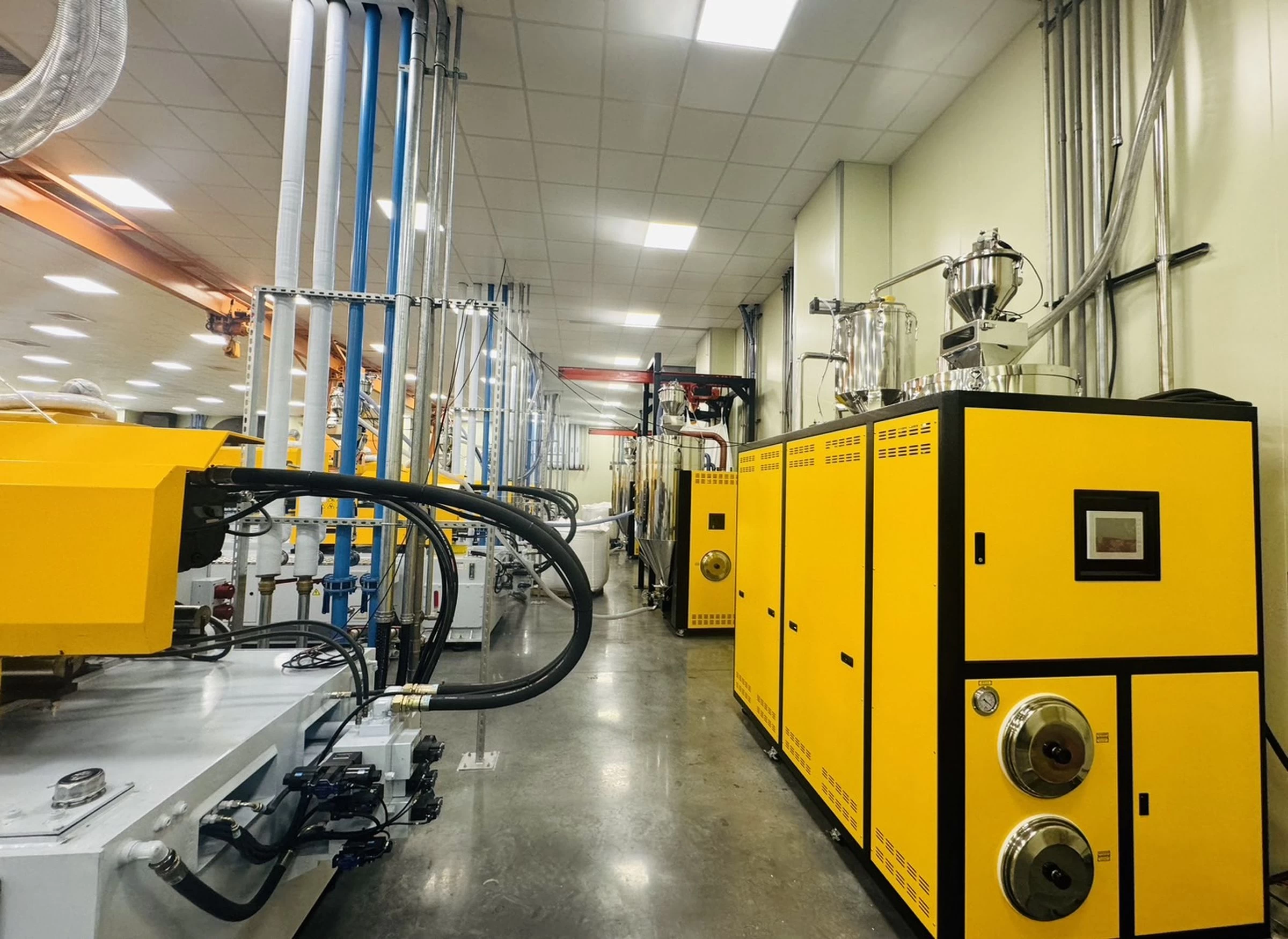
In the competitive landscape of plastic injection and extrusion, PET (Polyethylene Terephthalate) stands as one of the most demanding materials. Its high hygroscopic nature means even a trace of moisture leads to structural failure. Historically, the industry has relied on desiccant drying, but a massive shift toward vacuum technology is happening.
When comparing a vacuum dryer vs. desiccant dryer, the choice is no longer just about removing water—it’s about cycle speed, energy ROI, and material integrity.
Quick Summary: Why Vacuum Technology Wins
The primary difference lies in the physics of moisture removal. Desiccant dryers use hot air and moisture-absorbing beads, requiring 4–6 hours to dry PET. Flying Tiger KJ Vacuum dryers lower atmospheric pressure to drop the boiling point of water, achieving the same results in 60–90 minutes. This shift results in 33% to 80% energy savings and significantly reduces thermal stress on the resin.
1. The Speed Revolution: Resin Drying Time Comparison
Time is money on the factory floor. In a traditional desiccant system, drying PET to the required moisture level (usually <0.005%) typically takes 4 to 6 hours. This forces manufacturers to start machines hours before a shift.
A vacuum dryer changes the physics. By lowering atmospheric pressure, the boiling point of water drops significantly. This allows for fast drying plastic resin, reducing the PET cycle to roughly 60 to 90 minutes.
- The Impact: React faster to production changes and eliminate the need for oversized, energy-wasting hoppers.
2. Analyzing the ROI of a 33% Reduction in Power Consumption for PET Lines.
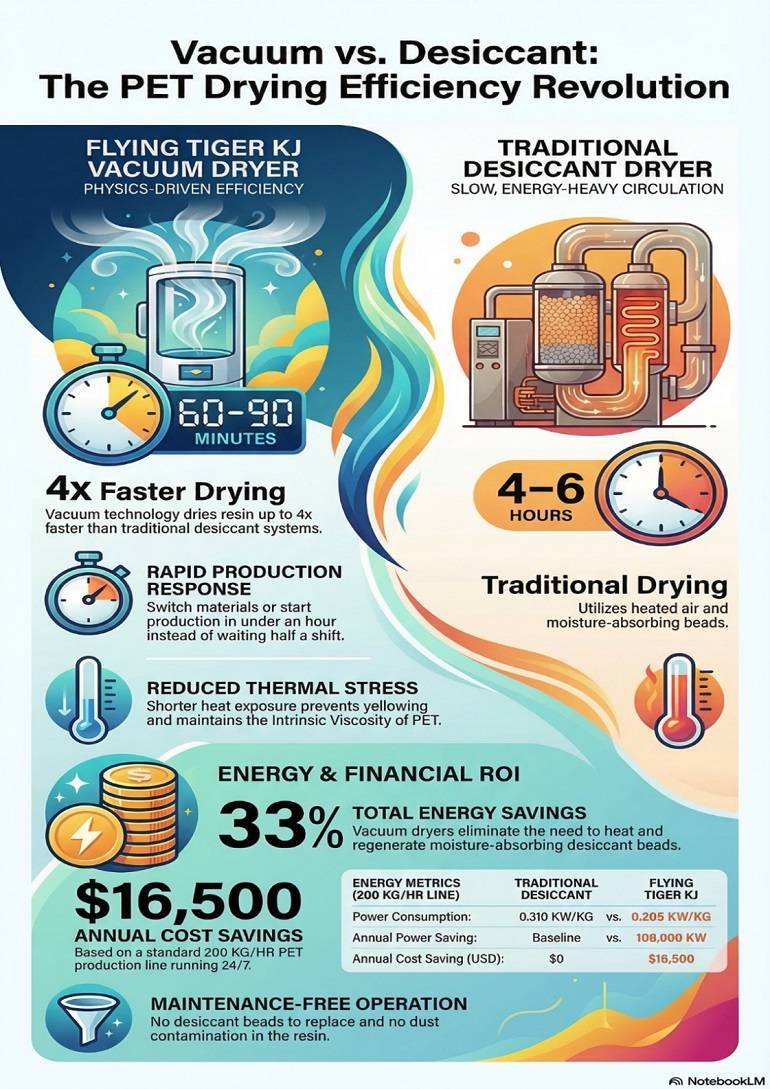
Energy prices are a top concern for modern manufacturing. Using Flying Tiger KJ’s standard analysis for a 200 KG/HR PET production line, the data reveals a clear "Efficiency Gap."
Table: 200KG/HR PET Production Line Energy Analysis
(Data sourced from Flying Tiger KJ Real-World Performance Logs)
| Efficiency Metric | Traditional Desiccant (KRD-800-3) |
TigerKJ Vacuum (KVD-200) |
|---|---|---|
| Total Power Load | 61.9 KW | 41.1 KW |
| Power Consumption (Per KG) | 0.31 KW/ KG | 41.1 KW |
| Power Saving Rate | Baseline | 33.61% Saving |
| Annual Power Saving | — | 108,000 KW |
| Annual Cost Saving (USD) | — | $16,500 USD* |
(Based on 300 days/year, 24 hours/day, at an estimated electricity rate of $0.15/KW.)
3. How Manufacturers Use Flying Tiger KJ to Solve Emergency Production Changes
To understand the true value of vacuum technology, let’s look at two common scenarios faced by modern factory managers:
Scenario A: The Emergency Production Change
Imagine it’s 10:00 AM. A sudden change in your production schedule requires you to switch from clear PET to a tinted PET resin.
- With a Traditional Desiccant Dryer: Your line stops. You must wait 6 hours for the new material to dry. Your machines are burning electricity while producing nothing. Production won't resume until 4:00 PM.
- With the Flying Tiger KJ Vacuum Dryer: You switch the material, and within 60 minutes, the resin is production-ready. By 11:00 AM, your line is back to full capacity.
- The Result: You saved 5 hours of peak production time and avoided idle labor costs.
Scenario B: Slashing the Utility Bill
A factory manager noticed that his drying department accounted for nearly 25% of the entire plant’s energy bill.
- The Action: He replaced his aging desiccant fleet with Tiger KJ KVD Vacuum Dryers.
- The Result: Each unit saved $16,500 USD per year. For his 10-line factory, he saved $165,000 USD annually in utility costs. The equipment paid for itself in less than 18 months.
4. How to Prevent PET Yellowing and Maintain Intrinsic Viscosity During Rapid Drying
PET is highly susceptible to thermal degradation if exposed to high heat for too long. Since vacuum dryers work 3x to 4x faster, the resin is subjected to much less "thermal stress."
- Prevents Yellowing: Shorter heat exposure keeps PET clear.
- Maintains Intrinsic Viscosity (IV): Ensures the final product meets clarity and mechanical strength standards.
- No Desiccant Dust: Unlike traditional dryers, there are no beads to break down, ensuring your material remains contamination-free.
FAQ: Vacuum vs. Desiccant Drying Technology
Redefine Your Standards with Flying TigerKJ
At Flying TigerKJ, we have pushed the boundaries of material preparation. Our Vacuum Dehumidifying Dryer is engineered specifically for those who refuse to compromise between speed and sustainability.
Key Benefits of the TigerKJ Vacuum Series:
- Rapid Startup: Go from cold start to production in under an hour.
- Maintenance-Free: No desiccant beads or rotors to replace.
- Green Technology: Optimized for reducing factory carbon footprints.
Stop Waiting, Start Saving
Don't let 6-hour drying times and high utility bills hold your production back.
Discover the future of PET drying: ➜ [ Flying TigerKJ Vacuum Dehumidifying Dryer Solutions ]


Back