How to Choose the Right Plastic Resin Dryer for Injection Molding and Maximize ROI in 2026
- 2026.05.22
- TONY WEN / FLYING TIGER KJ CO., LTD.

In precision injection molding, moisture is the invisible saboteur. Even trace amounts of water trapped within resin pellets lead to silver streaks, splay, and catastrophic structural brittleness. Successful plastic resin dryer selection isn't just about applying heat; it’s about matching drying kinetics to the specific molecular behavior of your polymer.
1. Understanding Material Dynamics: Hygroscopic vs. Non-Hygroscopic
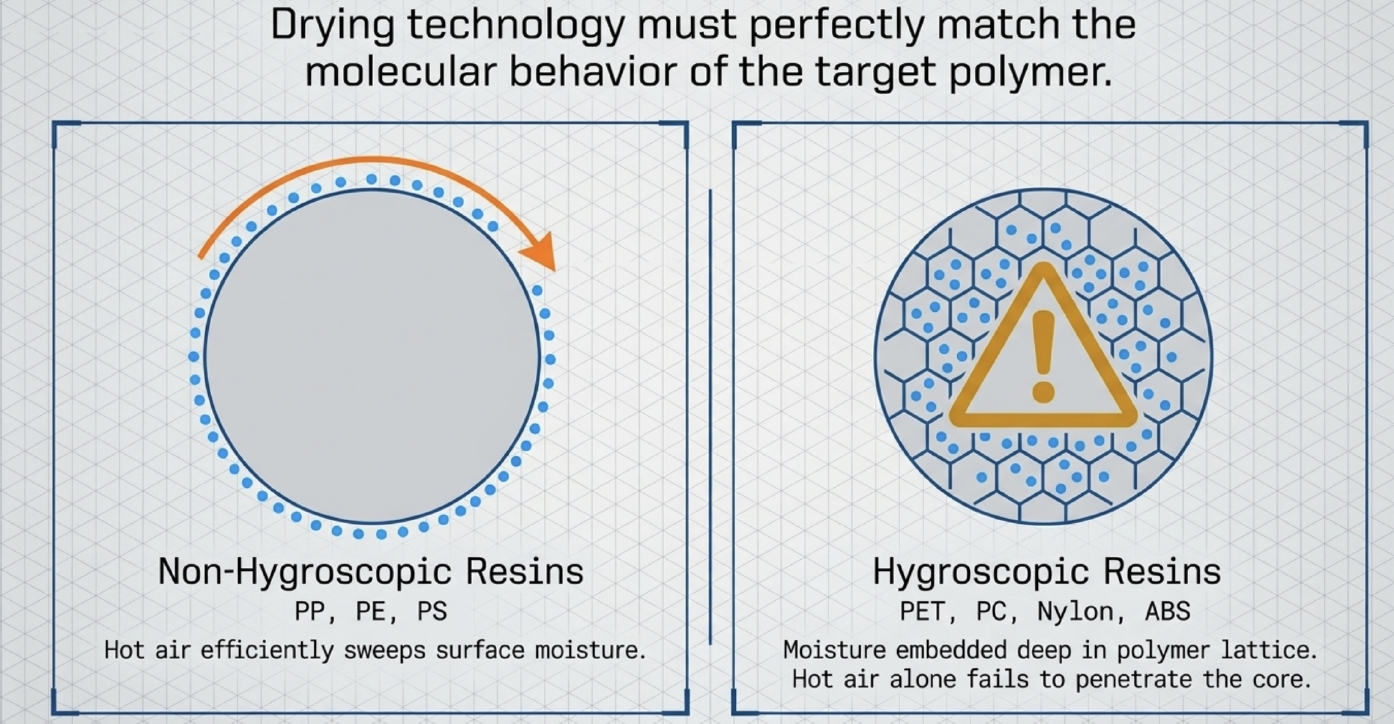
Before evaluating different types of plastic dryers, you must categorize your resin based on how it interacts with water:
- Non-Hygroscopic (e.g., PP, PE, PS): Moisture only collects on the surface. A cost-effective Hot Air Hopper Dryer is typically sufficient for rapid surface evaporation.
- Hygroscopic (e.g., PET, PC, Nylon, ABS): Moisture is absorbed deep into the molecular structure. Drying hygroscopic plastics requires specialized technology to create a vapor pressure gradient that "pulls" moisture from the core to the surface.
For a deeper technical breakdown of how different dehumidifying dryer technologies handle hygroscopic resins, see our complete dehumidifying dryer selection guide.
2. The Vacuum Advantage: Why PET & PC Require Advanced Tech
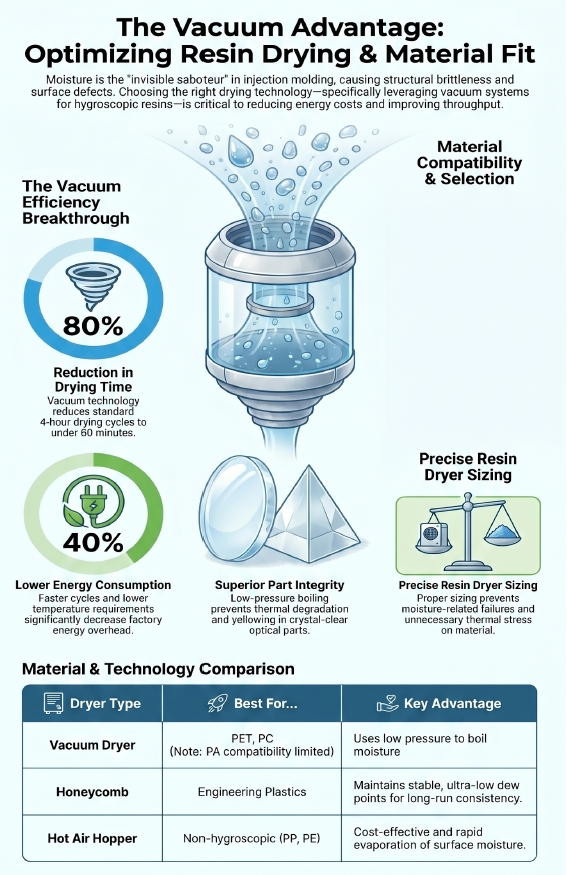
For high-performance engineering plastics, the "Time vs. Quality" trade-off is a major pain point. While traditional desiccant dryers rely on hours of hot air flow, a Vacuum Dryer utilizes low pressure to boil moisture at significantly lower temperatures.
Why Vacuum Technology Wins the ROI Battle:
- Drastic Time Savings: Reduce drying cycles from 4 hours to under 60 minutes—an 80% improvement in throughput.
- Energy Efficiency: Faster cycles and lower temperature requirements translate to a 40% reduction in energy consumption.
- Superior Part Integrity: By lowering the boiling point of water, you prevent thermal degradation and yellowing, ensuring the crystal-clear transparency required for optical PC and PET parts.
3. Precision Engineering: Mastering Resin Dryer Sizing
Incorrect resin dryer sizing is a primary cause of factory waste. Under-sizing leads to moisture-related failures, while over-sizing causes unnecessary thermal stress on the resin. To calculate the ideal hopper volume, use the standard engineering formula:
V = (m * t) / rho
V: Required Hopper Volume (Liters)
m: Material throughput per hour (kg/hr)
t: Recommended drying time (Hours)
rho: Bulk density of the resin (kg/L)
Flying Tiger Pro Tip: With a Vacuum Dryer, your "t" (time) is significantly shorter, allowing you to use a smaller, more space-efficient unit for the same hourly output (kg/hr).
4. Comparison of Drying Technologies
| Dryer Type | Best For... | Key Advantage | Time/Energy Savings |
|---|---|---|---|
| Vacuum Dryer | PET, PC | Uses low pressure to boil moisture at lower temps. | Saves 80% time & 40% energy |
| Honeycomb Dehumidifier | Engineering plastics, PA | Maintains a stable, ultra-low dew point (-40°C). | Reliable for long-run consistency |
| Hot Air Hopper Dryer | PP, PE, PS | Cost-effective and rapid surface drying. | Low initial investment |
| 3-in-1 Compact Dryer | Medical/Optical parts | Integrated dehumidifying, drying, and conveying. | Small footprint, zero contamination |
Why Flying Tiger is the Industry Standard?
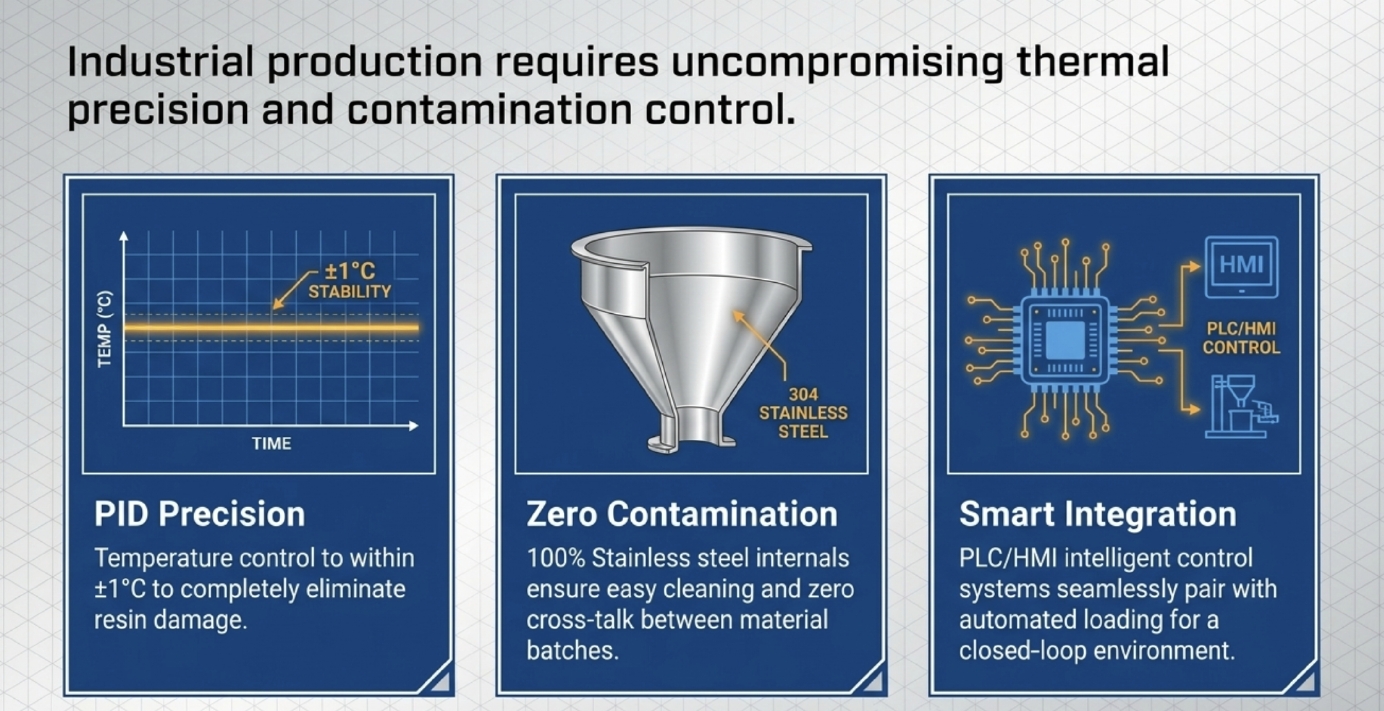
A Flying Tiger Dryer or Crystallizer is built to withstand the rigors of a 24/7 factory floor:
- PID Temperature Control: Precision to within ±1°C to prevent resin damage.
- Stainless Steel Internals: Prevents contamination and ensures easy cleaning during material changes.
- Smart Integration: Easily pairs with automated loading systems for a seamless "Closed Loop" production.
➜ [ Ready to upgrade your drying process? Explore the Flying Tiger Dryer & Crystallizer Series. ]


Back