Air-Cooled vs. Water-Cooled Chillers: Differences, Advantages, and Disadvantages
- 2026.09.25
- TONY WEN / FLYING TIGER KJ CO., LTD.
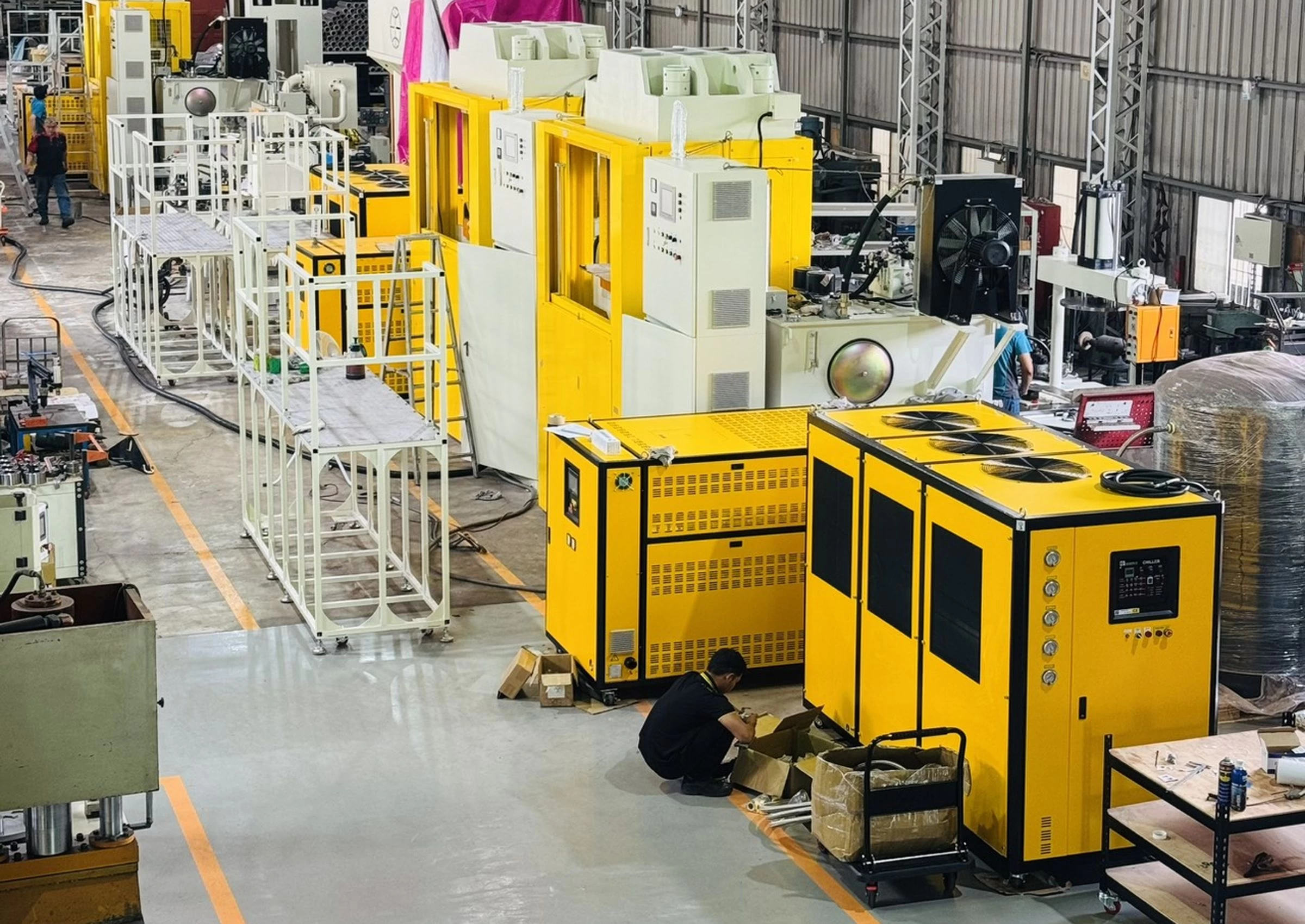
In an industrial plant, choosing the right cooling system can affect costs, process stability, and long-term performance. That's why comparing an air-cooled chiller with a water-cooled chiller is key before making an investment.
In this guide, we'll look at their main differences, advantages, disadvantages, and criteria for choosing the most suitable option for each project.
Differences Between an Air-Cooled and Water-Cooled Chiller
A chiller is an industrial refrigeration unit that removes heat from a process to maintain a stable temperature. The difference between an air-cooled chiller and a water-cooled chiller lies in how they dissipate that heat to the outside.
Below, we review how each system works and their main differences.
How an Air-Cooled Chiller Works
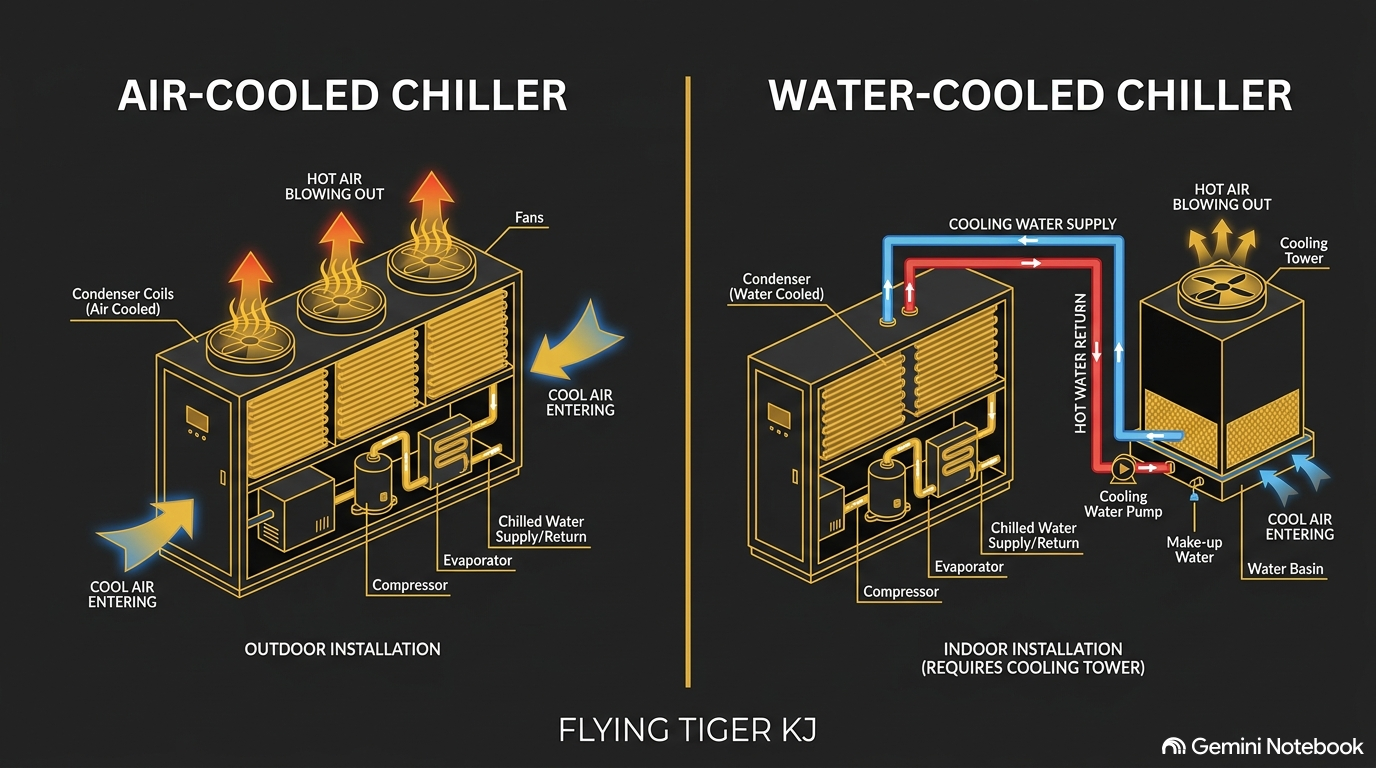
An air-cooled chiller uses fans to move ambient air through the condenser. The refrigerant releases heat into the outside air and the cooling cycle starts again.
This type of system is usually simpler to install, since it doesn't require a cooling tower or complex water infrastructure. That's why it can be a practical option for plants with limited space, lower thermal loads, or projects looking to reduce initial investment.
How a Water-Cooled Chiller Works
A water-cooled chiller uses water to remove heat from the condenser. In many cases, it works together with a cooling tower, which helps dissipate that heat outside the system.
This type of chiller usually offers greater efficiency and better thermal stability, especially in high-demand processes or continuous production. However, it requires a more complete installation and good water quality control to prevent scaling, corrosion, or performance loss.
| Criteria | Air-Cooled Chiller | Water-Cooled Chiller |
|---|---|---|
| Investment and Maintenance | Lower initial cost and simpler installation | Higher initial investment and more technical maintenance |
| Energy Efficiency | Can decrease in very hot environments | Usually more efficient under high thermal loads |
| Precision and Stability | Suitable for moderate applications | More stable for continuous or high-demand processes |
Related reading: What Is Thermal Efficiency? A Guide to Optimizing Plastics Processing
Advantages, Disadvantages, and When Each System Is Best
Choosing between an air-cooled and a water-cooled system depends on the thermal load, available space, water access, and the level of stability the process requires.
Air-Cooled Chiller
Advantages: quick and simple installation, lower initial cost, and less need for additional infrastructure.
Disadvantages: its performance can decrease when the ambient temperature is high, since it depends on outside air to dissipate heat.
Recommended uses: plants with limited space, projects with lower thermal demand, or facilities with restricted water access.
Water-Cooled Chiller
Advantages: higher energy efficiency and more consistent thermal stability, even when the outside climate is hot.
Disadvantages: higher initial investment, more complex installation, and dependence on good water quality to prevent scaling or performance loss.
Recommended uses: facilities with high thermal demand, continuous operation, or processes where temperature stability is critical.
Related reading: Types of Heat Exchangers: A Thermal Optimization Guide
How to Choose the Best Option for Your Project
Choosing between an air-cooled and a water-cooled chiller shouldn't be based on initial price alone. The decision should take into account the plant's actual conditions, the process's thermal load, and the long-term operating cost.
Before deciding, evaluate these critical factors for your operation:
- Required thermal power: If the process generates a high heat load or runs continuously, a water-cooled system can offer greater stability.
- Available space: If the plant has limited space or can't install a cooling tower, an air-cooled chiller can be more practical.
- Energy cost: When electricity consumption is a critical factor, it's important to evaluate not just the initial purchase, but also the equipment's efficiency throughout its entire service life.
- Water availability: If you don't have a steady water supply or prefer to simplify preventive maintenance by avoiding the risk of scaling, an air-cooled modular design is your best ally.
In this industry, no two plants are exactly alike. That's why at Flying Tiger KJ we offer a complete Chiller and Cooling Water Series of high-quality equipment, available in both air-cooled and water-cooled systems. Our equipment is designed to allow modular expansion and ensure precise, stable temperature control, adapting exactly to the variables of your production.
To ensure your parts' quality is flawless and free of margin for error, we recommend complementing your cooling system with our Mold Temperature Controller, achieving unmatched thermal stability.
On the other hand, we know that technical support and spare parts availability are vital. Industrial equipment requires maintenance, component inspection, and fast attention if a failure occurs; having our backing protects your investment in the long run.
Not sure which combination is ideal for optimizing your operating costs? Our team of professionals is ready to analyze your project. Contact us today and get personalized technical guidance!
Frequently Asked Questions (FAQ)
Related reading:
Plastic Injection and Blow Molding: The Process and Applications
Industrial Dryers for Plastic: 4 Types and How to Choose the Right One


Back