The Ultimate Guide to Desiccant Air Dryers and Dew Point Control in Plastic Processing
- 2026.08.07
- TONY WEN / FLYING TIGER KJ CO., LTD.

Moisture control is a critical factor in high-quality plastic manufacturing. When standard drying methods fall short, understanding the role of a desiccant dryer dew point becomes essential for preventing material defects and maintaining production stability.
This guide covers why dew point matters in resin drying, how desiccant systems work, and how they support reliable, energy-efficient processing.
1. Why Dew Point in Air Dryer Systems Matters for Resin Moisture Content
Moisture is the invisible enemy in plastic manufacturing. When working with hygroscopic materials—such as Polyethylene Terephthalate (PET), Polyamide (PA), and Polycarbonate (PC)—these polymers naturally absorb moisture from the surrounding air before they even enter the processing line.
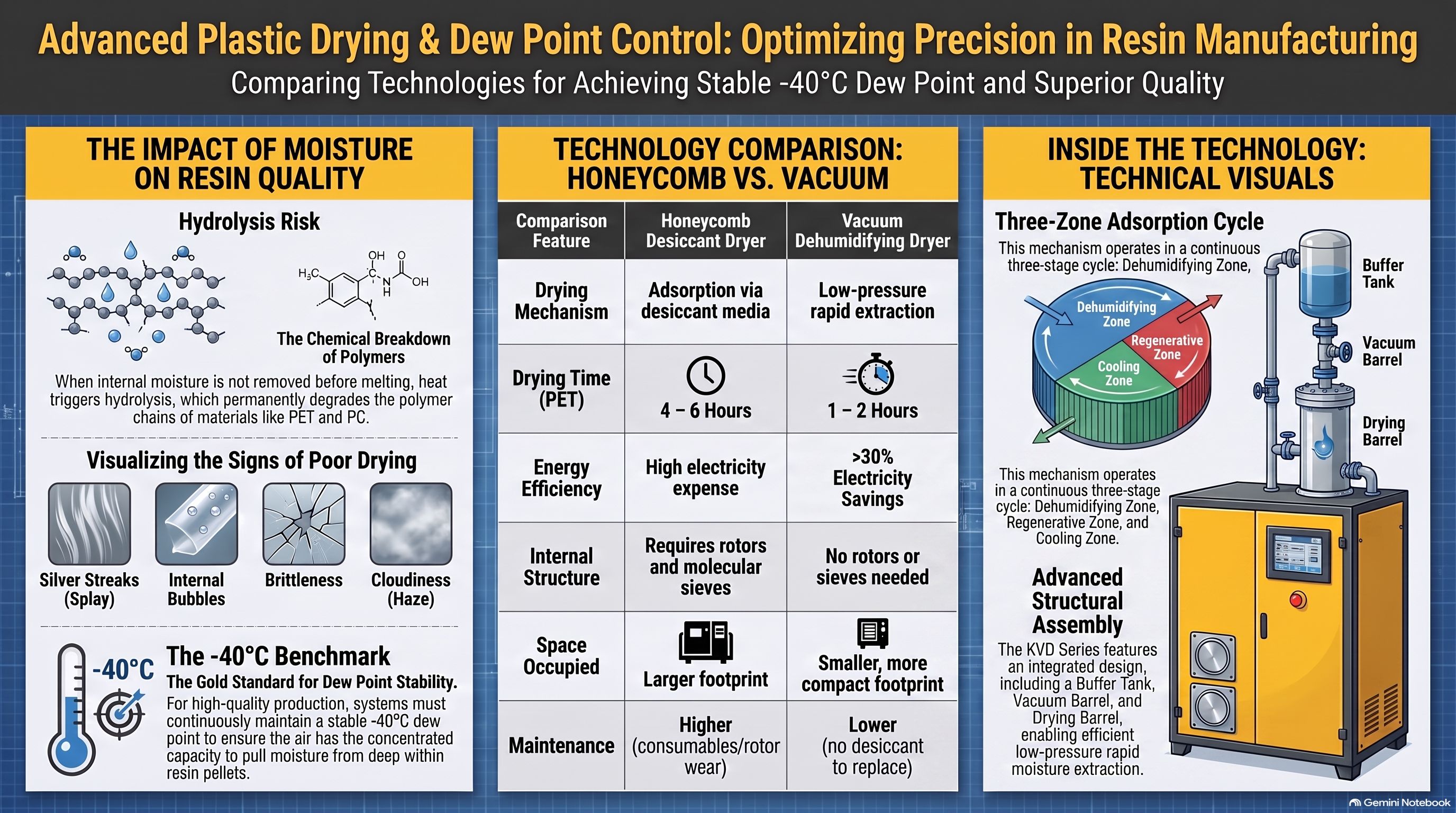
If this internal moisture is not properly removed before melting and molding, it becomes a severe production risk. High moisture content leads to hydrolysis, a chemical reaction where the polymer chains break down under heat.
This results in cosmetic and structural flaws, including silver streaks (splay), bubbles, brittleness, cloudiness (haze), and a drastic reduction in the product’s overall physical properties. Therefore, utilizing an effective air dryer system is an absolute necessity to bring the resin’s moisture content down to a safe processing range.
2. How Desiccant Dryer Dew Point Affects PET, PA, and PC Drying
When extracting moisture from hygroscopic plastics, the desiccant dryer dew point is directly tied to the overall drying performance. The lower the dew point of the process air, the stronger its ability to absorb and carry away moisture from the resin pellets.
For high-quality production, PET often needs to be dried to a strict target of roughly 50 to 200 ppm. Achieving this level of extreme dryness requires more than just hot air; it requires air with a highly concentrated capacity to absorb water.
However, the true measure of a successful drying system is not just hitting a low reading momentarily. The key to preventing defects is maintaining a stable dew point in the -40°C range continuously throughout the entire production cycle.
3. What Dew Point Means in Plastic Drying Systems
Simply put, the dew point is the temperature at which water vapor in the air begins to condense into liquid. In the context of plastic manufacturing, it refers specifically to the moisture condition of the process drying air used to treat hygroscopic resins.
Air with a lower dew point contains less water vapor, giving it a much stronger moisture absorption capacity. When this ultra-dry air circulates through the material hopper, it pulls moisture from deep within the pellets.
Maintaining this optimal dew point stability is what guarantees consistent production quality, which prevents material degradation and stabilizes the injection or extrusion process.
Further Reading: Mastering the Insert Molding Process: A Comprehensive Guide
4. Desiccant Dryer Working Principle and Key Performance Factors
To generate the low-dew-point air, desiccant dryers utilize the principle of adsorption. The system physically strips water vapor from the air, and this low-dew-point air is then blown into the hopper to remove water from the hygroscopic resins.
Since PET, PA, and PC each require entirely different drying conditions and machine setups, the system must be meticulously configured based on the following factors:
- Regeneration Efficiency
How well the system removes captured moisture from the desiccant media so it can continuously perform at peak capacity. - Airflow Volume and Design
Ensuring uniform air distribution so every pellet in the hopper receives consistent drying. - Drying Temperature
Matching the specific thermal requirements of the resin without causing degradation or premature melting. - Insulation Performance
Preventing heat loss in the hopper to maintain thermal efficiency and reduce energy waste. - Hopper Residence Time
Allowing the resin to stay in the hopper long enough for moisture to migrate from the core of the pellet to the surface. - Resin-Specific Parameter Settings
Customizing the PID control and process parameters to match the unique physical properties of PET, PA, or PC.
Further Reading: Mould Temperature Controller: Operation, Types, and Maintenance
5. Comparing Desiccant, Refrigerated, Infrared, and Vacuum Drying Technologies
Selecting the right drying technology is crucial for optimizing yield rates and energy consumption. Below is a comparison of the major technologies used in plastics processing:
| Technology | Primary Mechanism | Best Use Cases & Characteristics |
|---|---|---|
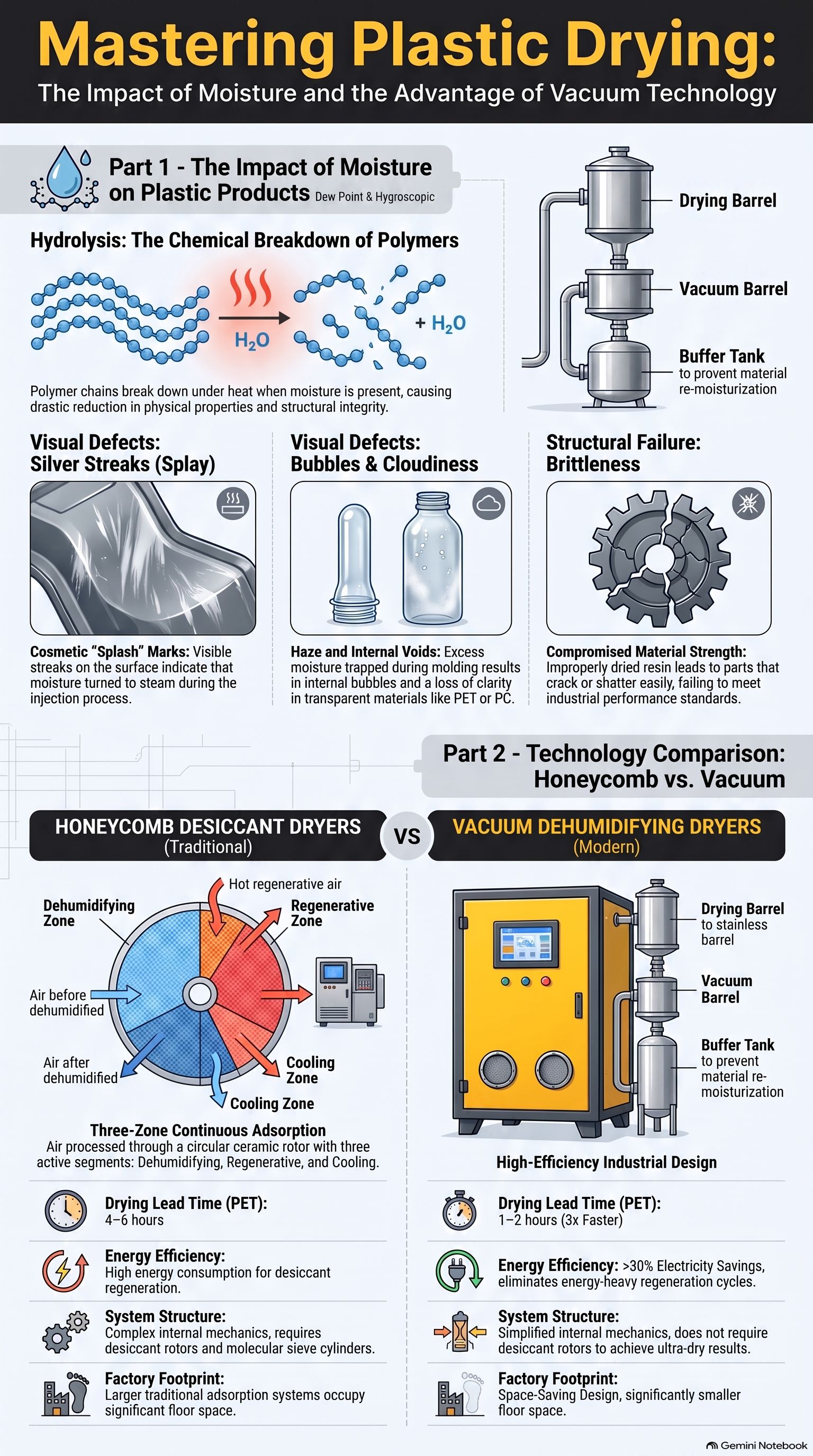
| Desiccant Dryers | Adsorption via desiccant media | Best for stable, continuous drying of hygroscopic engineering plastics. However, it requires 4-6 hours to dry PET. |
| Refrigerated Dryers | Cooling and condensation | Useful for general air-drying contexts and non-hygroscopic resins, but usually not sufficient for demanding low-moisture applications. |
| Infrared Dryers | Direct radiant heating | Extremely fast-heating and useful in selected applications, such as rPET crystallization, depending on the process layout. |
| Vacuum Dryers | Rapid moisture extraction via low pressure | Removes moisture by lowering the atmospheric pressure inside the chamber, accelerating evaporation without relying solely on low-dew-point air. |
Achieving ultra-low dew points using traditional methods often involves a trade-off with high energy consumption and long processing times. Flying Tiger KJ helps address this challenge with a wide range of advanced dryers built for more efficient moisture control.
The infrared rotary dryer improves heat transfer, shortens drying time, and supports faster material preparation in demanding production environments. The vacuum dehumidifying dryer provides a revolutionary alternative. By lowering atmospheric pressure to rapidly extract moisture, it halves processing times and avoids the high energy costs.
Unsure which system is right for your facility? Contact Flying Tiger KJ today. Our team can help you design a resin drying system optimized for maximum efficiency and reliability.
6. FAQs
Further Reading:
- Warpage in Plastic Injection Molding: Causes & Proven Solutions
- Sink Marks in Injection Molding: Causes, Fixes, and Prevention


Back